
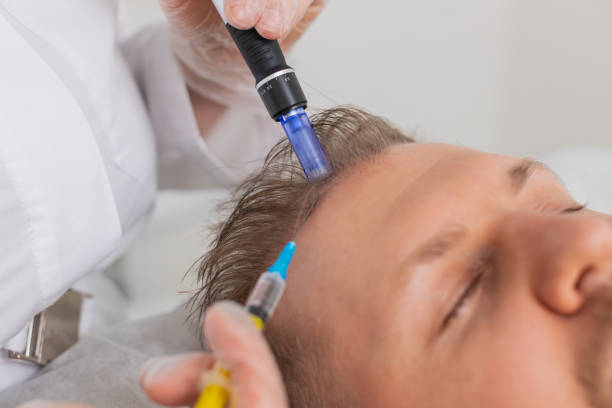
Before-and-after photographs can help people understand what a hair treatment may look like, but they can also be misleading when images are poorly standardized. When researching Exosome Hair in Dubai, patients should evaluate photographs for consistent lighting, camera position, hair length, styling, scalp visibility, and the time between images rather than judging results from a single dramatic comparison.
Why Before-and-After Photos Need Context
Hair photographs are not as objective as they appear.
Changes in lighting, hairstyle, hair moisture, camera angle, and even the direction in which the hair is combed can make the scalp appear substantially different.
This is especially important for regenerative hair treatments because expected changes can be gradual and may involve density, shaft appearance, or reduced visibility of the scalp rather than an instant transformation.
A credible photograph should therefore be viewed as documentation rather than proof of guaranteed treatment success.
The Camera Angle Can Change the Result
A small change in camera position can alter how much scalp is visible.
Photographs taken directly above the crown may show a different density pattern from photographs taken from a lower angle. Similarly, a receding hairline can appear more or less prominent depending on how far the camera is positioned from the forehead.
For meaningful comparisons, the camera should remain at a similar distance and height.
Look for consistent viewpoints
Useful comparison sets may include:
- Front hairline
- Left temple
- Right temple
- Top of scalp
- Crown
- Central part
- Areas of diffuse thinning
The exact views should remain consistent between baseline and follow-up photographs.
Lighting Can Create Artificial Improvement
Lighting is one of the easiest variables to manipulate unintentionally.
Strong overhead illumination can increase scalp visibility, while softer frontal lighting may make hair appear fuller.
A photograph taken outdoors in bright sunlight can therefore look very different from one taken indoors under controlled lighting.
For reliable comparisons, photographs should ideally use similar lighting conditions.
What to look for
When comparing two images, ask:
- Is the light coming from the same direction?
- Is the brightness similar?
- Is the scalp equally illuminated?
- Are shadows present in one photograph but not the other?
- Was a flash used?
- Is one image heavily exposed or darker?
If these variables change significantly, visual differences should be interpreted cautiously.
Hair Styling Can Make Density Look Different
Hair direction has a major effect on perceived fullness.
Hair that is brushed toward the center can cover areas of reduced density. Hair separated deliberately to expose the scalp can make the same area appear considerably thinner.
Hair products can also alter the appearance of individual strands.
Gel, oil, mousse, sprays, and wet hair can cause strands to group together, potentially changing how much scalp can be seen.
For stronger comparisons, the hair should be photographed in a reasonably consistent state.
Hair Length Matters Too
A change in hair length can create an illusion of increased density.
Longer hair can provide more visual coverage, while shorter hair may expose the scalp more clearly.
If the baseline photograph shows short hair and the follow-up shows considerably longer hair, the images are difficult to compare directly.
The most useful before-and-after documentation keeps hair length and grooming relatively consistent.
Time Between Images Changes the Interpretation
The timing of photographs is another important factor.
Hair does not respond to every intervention instantly. Follicular biology, hair growth cycles, and the natural rate of hair production mean that meaningful assessment may require an appropriate observation period.
A photograph taken shortly after a procedure cannot necessarily demonstrate the final outcome.
Likewise, an image taken many months later may show changes influenced by other treatments, natural disease progression, lifestyle changes, or unrelated factors.
A credible image set should clearly identify when each photograph was taken.
Density and Thickness Are Different Measurements
A person may interpret fuller-looking hair as increased density, but those concepts are not identical.
Density refers broadly to the number of hairs within an area, while thickness concerns the diameter or caliber of individual shafts.
A treatment could potentially affect the appearance of hair without producing the same degree of change in total follicular density.
This distinction is particularly relevant when assessing exosome hair results.
Photographs can suggest visual improvement, but they cannot independently establish exactly what biological change occurred.
What a Strong Photo Set Should Show
A useful photographic record typically includes more than one attractive “after” image.
| Documentation factor | Stronger comparison | Weaker comparison |
|---|---|---|
| Camera position | Consistent | Different angles |
| Lighting | Similar conditions | Dramatically different lighting |
| Hair length | Comparable | Major length change |
| Hair styling | Similar | Different styling |
| Viewpoints | Multiple standardized views | One selected angle |
| Timing | Clearly documented | Unclear |
| Image editing | Minimal | Heavy enhancement |
| Scalp visibility | Comparable exposure | Deliberately concealed |
The goal is not to make photographs look identical. It is to minimize variables that can distort interpretation.
Watch for Hairline Position Tricks
The hairline is particularly vulnerable to photographic manipulation.
Pulling hair forward, changing the angle of the forehead, altering the camera height, or using different hair lengths can make the hairline appear substantially changed.
A useful comparison should show the complete relevant area rather than cropping tightly around the most favorable section.
The temples should also be visible when evaluating frontal changes.
Crown Photographs Require Special Attention
The crown can be difficult to photograph consistently because it is curved and affected by overhead lighting.
A small change in camera elevation can alter the amount of visible scalp.
This means crown photographs should ideally be captured from a repeatable position with similar lighting and hair preparation.
One unusually favorable crown photograph should not be treated as definitive evidence of treatment effectiveness.
The Role of Trichoscopy
Standard photographs provide useful visual information, but clinical assessment can involve more detailed examination.
Trichoscopy allows clinicians to inspect scalp and hair characteristics at magnification. Depending on the clinical situation, it may help evaluate hair shaft variation, follicular structures, scaling, inflammation, and other features that cannot be reliably assessed from ordinary photographs.
This can provide additional context when evaluating a hair-loss pattern.
Photography and trichoscopic assessment therefore serve different purposes.
One documents visible changes; the other can provide more detailed information about scalp and follicular characteristics.
Why One Patient's Photos Cannot Predict Another's Result
Even authentic before-and-after photographs represent individual cases.
Hair-loss causes differ. So do age, genetics, baseline density, follicular miniaturization, scalp health, concurrent treatments, and treatment protocols.
A strong photograph can demonstrate that change occurred in one individual. It cannot guarantee that another person will experience the same result.
This is why responsible providers should avoid presenting selected photographs as universal outcome predictions.
Compare Like With Like
One of the simplest rules for interpreting results photographs is to compare similar conditions.
A useful mental checklist is:
Same angle + similar lighting + similar hair length + similar styling + documented timing = stronger comparison.
When several of these variables change simultaneously, it becomes increasingly difficult to determine whether the visible difference represents genuine treatment-related change.
Signs of More Credible Visual Documentation
When reviewing a clinic's photographic evidence, look for consistency rather than dramatic transformation.
More useful documentation may include:
- Multiple scalp angles
- Clearly identified treatment dates
- Similar lighting
- Comparable hair length
- Unedited photographs
- Consistent backgrounds
- Similar camera distance
- Full views of the relevant treatment area
- Follow-up images taken at clinically meaningful intervals
The presence of these features does not independently prove treatment effectiveness, but it makes visual evidence easier to interpret.
Signs That Require Caution
Some photographic patterns should encourage a more critical approach.
Be cautious when:
- Only the best angle is shown
- Before and after lighting is completely different
- Hair styling changes dramatically
- The scalp is visible in one image but covered in another
- The treatment interval is not stated
- Photographs appear heavily edited
- Images are cropped to hide surrounding areas
- Results are presented as guaranteed
- A single photograph is used to represent every patient
None of these features automatically proves that a photograph is misleading. They simply reduce its value as objective documentation.
How Dubai Patients Can Evaluate Treatment Claims
Dubai has a highly competitive aesthetic market, so patients may encounter a wide range of promotional material online.
A polished photograph should not replace questions about diagnosis, treatment rationale, product information, clinical evidence, and follow-up.
This is especially relevant for emerging regenerative approaches, where research is developing and treatment protocols may vary.
A 2025 systematic review of clinical exosome studies for alopecia found encouraging improvements across several hair parameters but also emphasized limitations such as small study populations, heterogeneous protocols, differing exosome sources, and inconsistent follow-up.
Visual marketing should therefore be considered alongside—not instead of—clinical evidence.
A Better Way to Judge Exosome Hair Results
Rather than asking only, “Does the after photograph look better?” consider several questions:
- Is the same area being photographed?
- Is the camera position comparable?
- Is the lighting consistent?
- Is the hair similarly styled?
- Is the hair length comparable?
- How long after treatment was the photograph taken?
- Were other hair treatments performed during the interval?
- Is the change visible from multiple angles?
- Is the result supported by objective clinical assessment?
- Does the provider explain limitations as well as potential benefits?
This approach produces a more balanced interpretation.
Photographs Are Evidence, Not a Guarantee
Before-and-after images have genuine value when they are collected systematically and presented transparently.
They become less useful when lighting, styling, timing, camera position, or editing make comparisons difficult.
For people researching Exosome Hair in Dubai, the strongest approach is to combine photographic documentation with professional assessment, realistic expectations, and an understanding of the current evidence.
Patients exploring broader hair and aesthetic treatment options in Dubai can review the services and clinical information available through Tajmeels Clinic before discussing an appropriate treatment pathway with a qualified professional.
A credible hair-treatment decision should be based on the whole clinical picture—not on the most impressive photograph.

 English
 French
 Spanish
 Portuguese
 Deutsch
 Turkish
 Dutch
Dutch
 Italiano
 Russian
 Romaian
 Portuguese (Brazil)
 Greek
Greek