
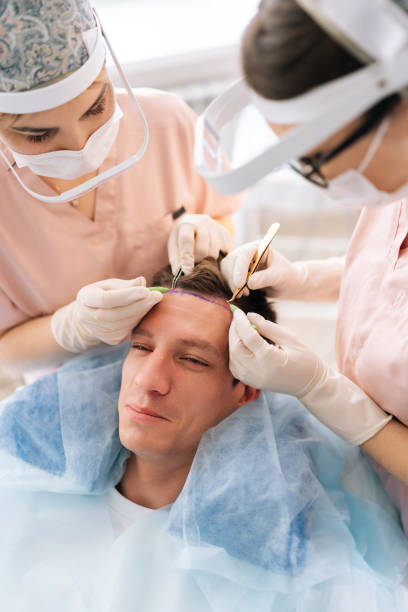
When both the front and crown are thinning, deciding where to place limited donor follicles can be more difficult than treating a single area. A balanced restoration considers facial framing, crown visibility, existing native hair, donor capacity, and the possibility of future progression rather than automatically dividing grafts equally.
For suitable patients, Hair Transplant in Dubai can be planned around these competing priorities to create a more cohesive appearance. The goal is not necessarily to maximize density in both zones, but to use available follicles where they can provide meaningful visual improvement.
Why Hair Transplant in Dubai Requires Crown and Hairline Prioritization
The hairline and crown have very different aesthetic and anatomical roles.
The frontal region frames the face, while the crown influences how the scalp appears from above and behind. Treating them as identical recipient zones can lead to inefficient graft distribution.
The hairline has immediate facial impact
Changes at the front of the scalp can alter the apparent shape of the face.
A carefully positioned hairline can restore definition while maintaining a mature appearance. However, aggressive lowering or excessive density can consume donor resources that might otherwise be used elsewhere.
The crown has a different visual pattern
The crown usually contains a whorl, meaning hair changes direction around a central point.
Its affected area can also be surprisingly broad. Attempting to fill the entire crown at maximum density may require substantial graft resources.
Hair Transplant in Dubai: Comparing the Two Restoration Zones
The right priority depends on the patient's individual pattern rather than a fixed rule.
| Factor | Hairline restoration | Crown restoration |
|---|---|---|
| Main aesthetic role | Frames the face | Influences scalp appearance from above |
| Growth pattern | Primarily directional | Often rotational around the whorl |
| Design priority | Hairline position and transition | Whorl integration and coverage |
| Graft demand | Depends on width and desired density | Can increase with crown size |
| Native hair | Often surrounds recession | May remain within thinning crown |
| Lighting sensitivity | Visible under frontal and overhead light | Often more apparent under overhead light |
| Long-term concern | Future recession behind the hairline | Expansion of crown thinning |
Hair Transplant in Dubai and the Case for Frontal Priority
In some patients, the frontal region may provide the greatest cosmetic return from transplantation.
The hairline directly affects facial proportions, while frontal thinning is often noticeable during normal face-to-face interaction.
A conservative hairline can preserve options
The objective is not to create the lowest possible frontal line.
A mature position may provide sufficient facial framing while reducing unnecessary graft consumption.
The frontal transition needs graduated density
The leading edge generally benefits from a softer arrangement than the deeper frontal zone.
Appropriate follicular-unit selection and gradual density changes can help the restored hairline blend with existing growth.
Hair Transplant in Dubai and Crown-Focused Planning
Crown restoration can be appropriate when the posterior thinning is the dominant cosmetic concern.
However, the crown's size and rotational growth pattern need to be considered before establishing a graft target.
Crown size changes graft requirements
A small crown thinning area and an extensive crown defect are very different surgical problems.
If the affected zone is large, a limited donor supply may not support maximum density throughout the entire area.
The whorl influences placement
Hair around the crown changes direction as it follows the natural whorl.
Grafts therefore need to be positioned with attention to this rotational pattern rather than arranged in uniform lines.
Hair Transplant in Dubai: What Happens When Both Areas Need Treatment
Patients with simultaneous frontal and crown thinning may face a genuine allocation decision.
Trying to treat both zones identically can spread donor follicles too thinly.
A balanced strategy
A surgeon may consider assigning greater priority to one region while providing supporting coverage to the other.
The exact ratio depends on donor availability, existing density, hair caliber, the extent of loss, and the patient's primary cosmetic concern.
Why equal graft distribution may not work
Imagine a patient with limited donor reserves and significant frontal recession but only mild crown thinning.
Splitting grafts equally between the two regions could under-treat the hairline while using follicles on a crown that still has useful native coverage.
Another patient could present the opposite pattern and require a different strategy.
Hair Transplant in Dubai and Existing Native Hair
Native hair changes the equation in both the frontal and crown regions.
A thinning crown with substantial existing hair may need reinforcement rather than complete reconstruction.
Likewise, a receding frontal area may have enough remaining density behind the hairline to support a graduated transition.
Preserving useful follicles
Recipient-site planning should account for the position and direction of existing follicles.
Unnecessary disruption can reduce the contribution that native hair makes to the final appearance.
Native hair may continue changing
Existing hair can remain susceptible to the underlying hair-loss process.
Long-term planning should therefore consider what the scalp may look like if some native follicles continue to thin.
Hair Transplant in Dubai: Using Visual Impact to Set Priorities
Graft allocation is partly a question of visual return.
The area that is most noticeable to the patient is not necessarily the area with the greatest surface area.
Facial framing
A change in the frontal region can have a strong effect because it alters the relationship between forehead and hair.
Overhead visibility
Crown thinning can become more noticeable under strong overhead lighting. This can be particularly relevant in Dubai, where intense sunlight may expose scalp visibility more clearly.
Personal hairstyle
Patients who wear their hair short, swept back, or in styles that expose the crown may have different priorities from those whose usual hairstyle provides coverage.
Hair Transplant in Dubai and Long-Term Balance
Restoration should be planned for more than the immediate postoperative result.
If the frontal hairline is rebuilt aggressively while native hair behind it continues to recede, the restored region may eventually appear isolated.
Similarly, using a large proportion of donor follicles on the crown could leave fewer resources for future frontal changes.
A sustainable restoration strategy
A long-term plan may consider:
- Current hair-loss pattern
- Likely progression
- Donor density
- Hair caliber
- Existing native coverage
- Hairline position
- Crown dimensions
- Patient priorities
- Potential future procedures
The objective is to create a result that remains visually coherent as the patient's hair changes.
Hair Transplant in Dubai and Dubai Lifestyle Considerations
Patients living in Dubai may notice scalp visibility differently depending on lighting conditions. Strong outdoor sunlight can make crown thinning particularly apparent from above, while professional environments may place greater emphasis on frontal appearance.
During recovery, patients should follow individualized instructions concerning sun exposure, washing, exercise, and scalp protection.
Dubai's high temperatures and frequent indoor air conditioning can also affect scalp comfort, making appropriate postoperative care important.
Hair Transplant in Dubai: Questions to Ask About Crown and Hairline Balance
Should the hairline or crown be treated first?
There is no universal priority; the decision depends on the patient's pattern, donor supply, existing coverage, and cosmetic goals.
Can both areas be treated in one procedure?
Sometimes, but feasibility depends on the total recipient area and available donor follicles.
Why might the crown receive fewer grafts?
The crown can require substantial resources because of its size and rotational growth pattern.
Can existing crown hair reduce the graft requirement?
Yes. Remaining native density can provide useful coverage and may influence how grafts are distributed.
Why is future hair loss important?
Native hair can continue thinning, so graft allocation should preserve a sensible long-term strategy.
The Strategic Investment
Balancing the crown and hairline is ultimately a question of visual priorities, anatomy, and donor resources. A well-planned Hair Transplant in Dubai strategy should determine where each graft can contribute most effectively instead of treating every thinning area with the same density target.
Patients considering individualized restoration can explore Tajmeels Clinic when discussing whether their hairline, crown, or both regions should receive priority based on their current pattern and long-term goals.

 English
 French
 Spanish
 Portuguese
 Deutsch
 Turkish
 Dutch
Dutch
 Italiano
 Russian
 Romaian
 Portuguese (Brazil)
 Greek
Greek