
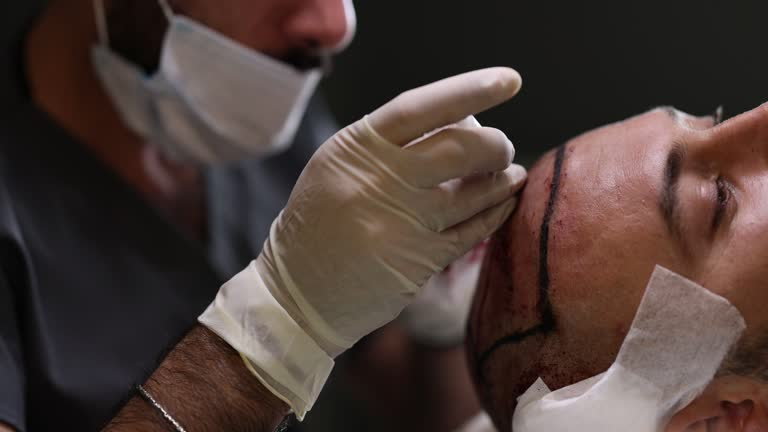
A small bald area can often be approached differently from widespread scalp hair loss. For suitable patients, FUE Hair Transplant in Dubai can restore a localized area by placing carefully selected follicular units where hair is absent or significantly depleted.
The important consideration is whether the bald area is stable and suitable for transplantation. A specialist must distinguish a genuinely localized defect from early diffuse thinning, active scalp disease, or a temporary shedding process before planning graft placement.
Why a Small Bald Area Needs Individual Mapping
A localized bald patch may look straightforward from a distance, but its boundaries can be irregular and its relationship with surrounding follicles can vary significantly.
The Visible Boundary May Not Be the True Boundary
Some bald areas have a clearly defined edge, while others gradually transition into miniaturized or widely spaced hair. Magnified examination can reveal follicles that are too fine to be easily noticed.
This helps determine whether grafts are required throughout the visible area or only in specific portions.
The Surrounding Hair Influences the Design
Dense native hair around a small bald area can make the defect more visually noticeable. Conversely, if the surrounding region is already thinning, the problem may represent part of a broader pattern.
The restoration plan should therefore evaluate the complete surrounding region rather than treating the patch in isolation.
What Can Cause a Small Bald Area?
Not every localized area of hair loss has the same cause. A transplant should be considered only after the underlying reason for the loss has been evaluated.
Pattern Hair Loss
Early androgenetic hair loss can sometimes create localized areas where density decreases before surrounding regions become noticeably affected.
If the process is progressive, future loss needs to be considered when planning the restoration.
Previous Injury or Surgery
Trauma, surgical procedures, or other injuries can leave localized areas without normal follicular growth. Scar tissue may differ from healthy scalp and requires additional assessment before implantation.
Previous Hair Transplantation
A small bald area may also appear after an earlier transplant because of incomplete coverage, graft loss, changes in native hair, or differences in density.
Corrective planning requires examination of both the recipient area and the original donor region.
How FUE Targets a Small Bald Area
FUE allows individual follicular units to be extracted from the donor area and implanted into selected recipient sites.
Recipient Sites Are Placed Where Coverage Is Needed
Rather than distributing grafts broadly, the surgeon can map the localized defect and determine where follicles will have the greatest visual effect.
The spacing and orientation of sites should transition naturally into the surrounding hair.
Graft Selection Depends on Location
A small frontal defect may require finer single-hair units near its boundary, while a thicker central area may benefit from naturally occurring multi-hair grafts.
The objective is to reproduce the existing pattern rather than placing identical grafts throughout the patch.
Why Hair Direction Matters in Small Restorations
The smaller the treated area, the more important integration can become. A few poorly oriented grafts may be more noticeable when they are surrounded by otherwise normal native hair.
Matching the Existing Growth Pattern
Recipient channels should follow the direction of surrounding follicles. The surgeon considers both the surface emergence angle and the direction in which the native hair naturally lies.
This helps transplanted hair merge with the surrounding pattern after growth.
Avoiding an Artificial Density Block
Placing grafts at an identical distance from one another can create a visually distinct patch. Density should instead transition gradually toward the native hair.
This is particularly important where the bald area is surrounded by dense coverage.
Can a Small Bald Spot Be Filled Completely?
The goal is usually natural visual integration rather than guaranteeing that every square millimeter looks completely opaque under every condition.
Hair Characteristics Affect Coverage
Hair diameter, texture, curl, length, and color contrast with the scalp all influence how dense a restored area appears.
Two patients with similarly sized bald areas may therefore require different treatment plans.
The Scalp-to-Hair Contrast Matters
Dark hair against lighter scalp can make even a relatively small gap highly visible. A patient may notice the area more strongly under direct overhead lighting or with short hair.
A clinical assessment should account for these visual factors when setting expectations.
Native Follicles Around the Bald Area
If native follicles surround the defect, their condition can influence the restoration strategy.
Healthy Native Hair Provides a Natural Frame
Stable terminal hairs can help conceal the transition between transplanted and existing follicles. Grafts can be positioned within the depleted region while respecting the surrounding growth.
Miniaturized Hair Requires a Broader View
If the surrounding hairs are becoming progressively finer, the apparent bald patch may be the most visible portion of a larger process.
Treating only the empty center without considering the surrounding miniaturization could result in a density mismatch later.
When Small-Area FUE May Be Considered
Localized transplantation can be considered when the defect is stable, the recipient tissue is appropriate, and sufficient donor follicles are available.
Small Stable Defects
A localized stable area may be well suited to targeted graft placement because the treatment boundary can be clearly defined.
The surgeon can focus on achieving continuity with the surrounding hair rather than undertaking broad scalp reconstruction.
Localized Post-Surgical Loss
When hair has been permanently lost around a previous surgical site, transplantation may be considered after the tissue has matured sufficiently for assessment.
Scar tissue may require a modified approach because recipient-site characteristics can differ from normal scalp.
Small Areas After Earlier Transplantation
A limited gap following previous transplantation can sometimes be approached with additional grafts. However, the cause of the gap should be established before another procedure is planned.
Donor Planning Still Matters for a Small Defect
A small recipient area does not mean the donor area can be ignored. Every extracted follicle comes from a finite reserve.
Extraction Should Match the Restoration Need
The surgeon should identify suitable donor follicles rather than simply harvesting the closest available hairs. Donor characteristics should be compatible with the intended recipient area.
Future Hair Loss Should Remain Part of the Plan
A patient may eventually develop thinning elsewhere even when today's problem is limited to one small area.
Using donor follicles strategically can help preserve options for future restoration if the underlying hair-loss pattern progresses.
Can FUE Treat Small Areas on Different Parts of the Scalp?
The answer depends on anatomy and the cause of hair loss, but localized restoration can involve several regions.
Small Frontal Gaps
A limited gap near the frontal hairline requires careful control of hairline direction and graft caliber. Even a small number of grafts can influence the overall transition.
Localized Crown Defects
A small crown bald area needs recipient sites that follow the vertex's changing growth direction. The surrounding whorl provides the anatomical reference for placement.
Small Temple Defects
Temporal areas require finer grafts and carefully controlled angles because temple hair usually lies flatter and follows a distinctive direction.
The same FUE technique therefore cannot simply be applied identically to every small scalp defect.
When a Small Bald Area Should Not Be Treated Immediately
A visible bald patch does not automatically mean transplantation is the next step.
Active Hair Loss
If the area is still changing rapidly, the final treatment boundary may not yet be clear. Establishing stability can be important before committing donor follicles.
Uncertain Diagnosis
Localized loss associated with inflammation, infection, autoimmune conditions, or other scalp disorders requires appropriate medical evaluation. Transplantation does not address an untreated underlying cause.
Insufficient Donor Supply
Even a small defect may not be appropriate for transplantation if the donor region lacks enough stable follicles or has significant miniaturization.
Graft Handling for Targeted FUE
Small restorations can require careful graft handling because each follicular unit may contribute noticeably to the final density.
Protecting Follicular Integrity
Extraction should minimize unnecessary trauma, while harvested grafts should be handled appropriately before implantation.
Accurate Recipient-Site Creation
Recipient channels need to correspond with the planned direction and spacing. This becomes particularly important when the surrounding native hair is dense.
The objective is to make the transplanted follicles visually disappear into the existing pattern once they mature.
Recovery After Small-Area FUE in Dubai
A targeted restoration does not eliminate the need for postoperative care. Patients should follow the clinic's instructions regarding washing, scalp contact, physical activity, and medications.
Dubai's high temperatures and strong sunlight make protection of the healing recipient area particularly relevant. Patients should also plan around outdoor exercise and prolonged heat exposure during the early recovery period.
Temporary redness or crusting can occur around the treated area. The transplanted hair may also shed before new growth develops, so early appearance should not be treated as the final outcome.
What Patients in Dubai Should Do Next
If a small bald area has appeared, the first step is to establish whether it is truly isolated and permanent. A detailed consultation can assess the patch itself, surrounding native follicles, donor quality, scalp condition, and the likely progression of hair loss.
Once the cause and stability are understood, a specialist can determine whether targeted graft placement is appropriate and how the restored area should blend into the surrounding hair. A personalized hair restoration assessment can provide the basis for that treatment plan.
Questions to discuss include:
Can FUE treat a very small bald spot?
Yes, selected stable localized defects can sometimes be treated with targeted follicular-unit transplantation.
Does a small bald area always need a transplant?
No. The cause, stability, native follicle condition, and donor supply should be assessed first.
Will the restored patch look different from surrounding hair?
It can blend naturally when graft selection, density, direction, and recipient-site placement are carefully matched to the surrounding hair.
Can a small bald patch become larger later?
Yes, if it is part of a progressive hair-loss pattern. Future progression should be considered during planning.
The Strategic Investment
Small bald areas can be good candidates for focused restoration when the loss is stable and the surrounding anatomy is favorable. The procedure still requires detailed diagnosis, donor assessment, graft selection, and precise recipient-site placement because localized defects can make inconsistencies particularly visible.
A targeted approach can restore coverage without treating unaffected scalp unnecessarily. Patients considering FUE Hair Transplant in Dubai can discuss the cause and boundaries of their specific bald area with Tajmeels Clinic before deciding whether localized transplantation is appropriate.

 English
 French
 Spanish
 Portuguese
 Deutsch
 Turkish
 Dutch
Dutch
 Italiano
 Russian
 Romaian
 Portuguese (Brazil)
 Greek
Greek