
popular dish remains available on the menu after its ingredients run out. The restaurant finishes a busy evening, yet the manager still needs several spreadsheets to understand the day’s performance.
These situations share a common problem: information is not reaching the right people at the right time.
For businesses exploring the top restaurant POS systems in the UAE, this is a useful starting point. Beyond processing payments, a well-configured POS should help orders, kitchen activity and management records stay connected.
The value becomes clearer when you follow what happens during an ordinary restaurant shift.
One Order, Several People, One Consistent Record
A single restaurant order can involve a waiter, cashier, kitchen team, drinks station and delivery employee. Each person needs different information, but everyone should be working from the same order.
Consider a table ordering two main courses, a starter and three drinks. One guest requests a different sauce, and another asks for the starter to arrive with the main course.
If the team relies on handwritten notes and repeated verbal instructions, there are more opportunities for details to disappear. A connected ordering process gives staff a consistent place to record those requests and check what was communicated.
During a POS evaluation, restaurant owners should follow an order through every stage. Enter it, modify it, send it to preparation and complete the bill. This reveals whether the workflow makes sense for the people who will use it.
Kitchen Visibility Can Improve Service Coordination
Guests usually ask the service team about delayed food, even though the answer sits in the kitchen.
When preparation status is visible, staff have a clearer basis for responding. They can check whether an order is waiting, being prepared or ready, depending on the statuses the system supports.
A kitchen display can help organise this information, but the screen alone is not the solution. Staff need agreed procedures for acknowledging orders, recording changes and marking items as complete.
For a restaurant with several preparation stations, the evaluation should also cover routing. Drinks, grilled dishes and desserts may need to reach different teams without losing their connection to the original order.
The aim is a process that keeps everyone informed without creating extra steps during service.
Menu Availability Needs an Operational Process
Few service problems are more avoidable than accepting an order for something the kitchen cannot prepare.
Keeping menu availability accurate requires coordination between stock records, kitchen staff and the ordering team. Software can support that coordination, but restaurants must establish who updates availability and when.
A restaurant selling the same dish through several channels should ask how changes are reflected in each one. Does an unavailable item need to be updated separately? Does a connected ordering channel receive the change automatically? Are any third-party connections required?
These questions are especially useful for businesses managing dine-in service alongside takeaway and online orders.
Inventory Data Becomes More Useful When Staff Record Changes
Sales records explain what customers bought. Stock records help explain what the restaurant used, purchased, transferred or discarded.
The relationship between them depends on the system’s capabilities and how carefully the restaurant maintains its data. Product-level stock tracking, for example, should not be assumed to include recipe-level ingredient deductions.
Before choosing software, define the level of detail your operation needs. A café might begin with packaged products and beverages. A larger kitchen may need purchasing records, ingredient quantities, waste tracking and stock transfers.
Whichever approach you choose, include the employees responsible for receiving deliveries and adjusting stock. If those tasks are confusing, the records are more likely to fall behind.
Multi-Branch Restaurants Need Both Shared Oversight and Local Detail
Opening another outlet introduces new questions. Which branch needs additional stock? Are menu changes applied consistently? Why are refunds higher at one location? Can each manager access the information relevant to their role?
A useful multi-branch setup should let owners review the business overall while investigating individual locations.
Central oversight also needs room for operational differences. Branches may have different menus, opening hours or product availability. Ask suppliers to demonstrate how shared settings and location-specific changes are managed.
This helps establish whether the proposed system fits the business you are building, as well as the outlet you operate today.
Where BizModo Fits Into the Evaluation
Businesses researching the Top Restaurant POS Systems in the UAE can include BizModo in their shortlist.
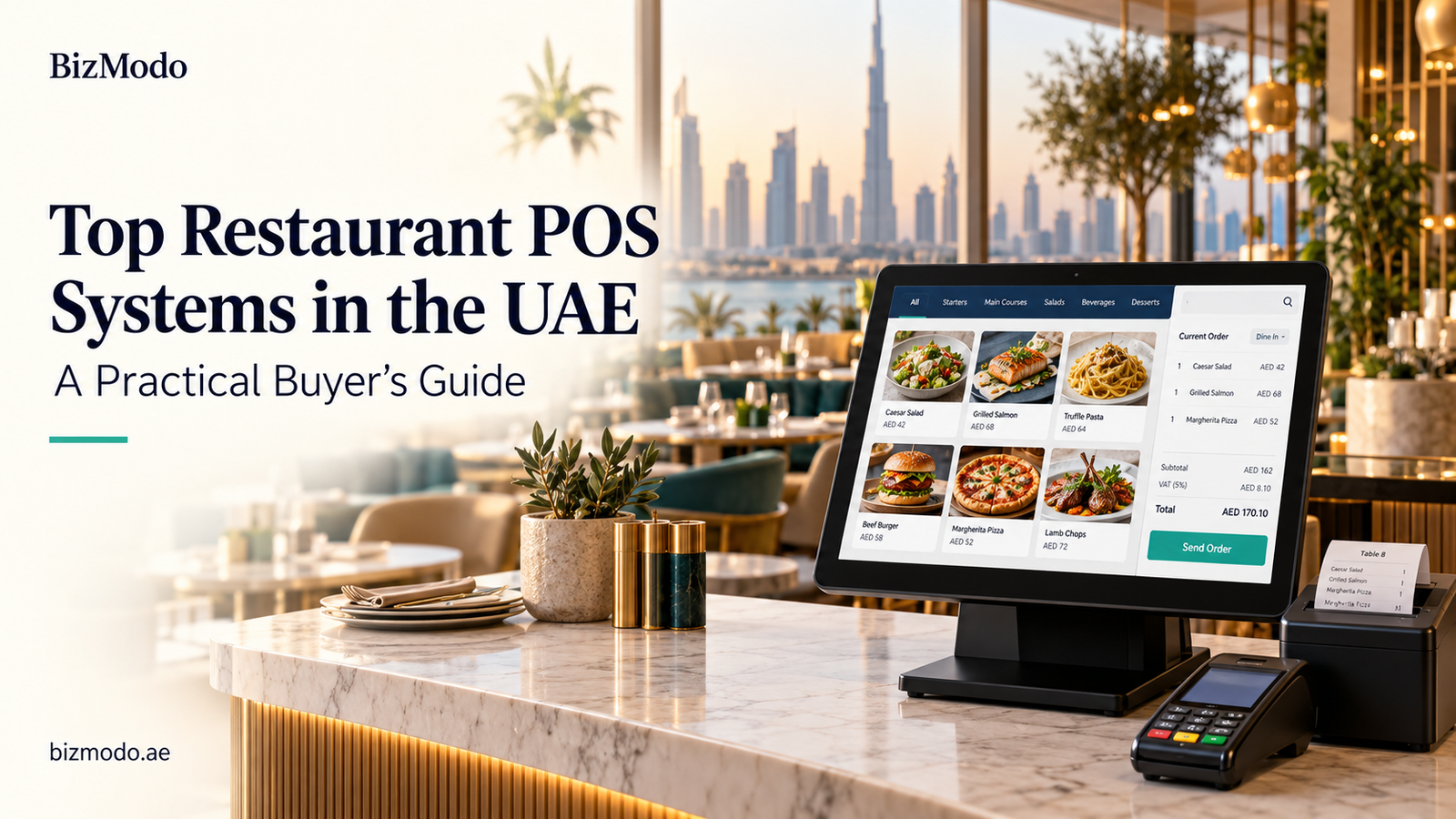
BizModo’s restaurant POS page describes tools for QR ordering, kitchen displays, table management, inventory and multiple locations. It also lists reporting features covering sales, cooking times and inventory wastage. These capabilities provide a starting point for evaluating how the platform could support connected restaurant operations.
A useful demonstration should use your actual menu structure and typical service situations. Ask the team to show how an order moves between staff, how changes are handled and what a manager can review afterwards. Confirm the package, equipment and configuration needed for each relevant feature.
A Good Launch Depends on Preparation
Once a restaurant chooses a POS, implementation deserves the same attention as selection.
Menus, prices, modifiers and employee permissions should be checked before live service. Staff should practise common tasks, including correcting an order, recording a refund and completing the end-of-shift process.
Start with the workflows that matter most. Adding every optional feature immediately can make training harder without improving the opening experience.
It also helps to agree on who owns the system internally. One person should coordinate menu updates, report questions and supplier support requests so that changes remain organised.
Choose Around the Way Your Restaurant Works
The right POS decision begins with the gaps in your current operation. Identify where orders lose detail, where staff wait for information and where managers spend time reconciling records.
Then ask each supplier to demonstrate those situations.
For UAE restaurant owners considering BizModo, bringing these real scenarios to a product demonstration will make the discussion more productive. The strongest reason to choose a system is seeing how it helps your team manage a complete shift with clearer information and fewer avoidable handoffs.

 English
 Arabic
 French
 Spanish
 Portuguese
 Turkish
 Dutch
Dutch
 Italiano
 Russian
 Romaian
 Portuguese (Brazil)
 Greek
Greek