
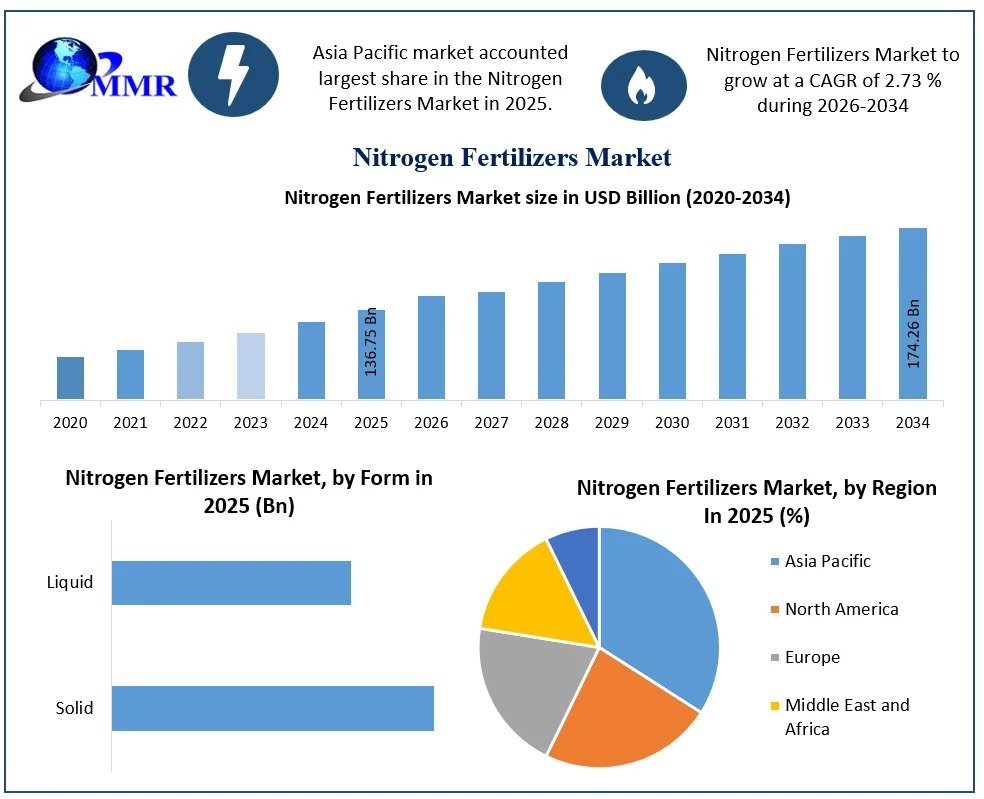
Global Nitrogenous Fertilizers Market to Reach USD 105.24 Billion by 2032, Growing at a CAGR of 5.7%
Source: Maximize Market Research
Date: November 24, 2026
Submitted by: Ankita Kagwade | Maximize Market Research
Global Nitrogenous Fertilizers Market Size & Growth Forecast
PUNE, India, November 24, 2026 — The Nitrogenous Fertilizers Market was valued at USD 71.39 billion in 2025 and is projected to reach USD 105.24 billion by 2032, growing at a CAGR of 5.7% during the forecast period (2026–2032). The market is expected to generate an incremental growth opportunity of USD 33.85 billion over the forecast period, supported by increasing global food demand, expanding agricultural activities, and the growing need to improve crop productivity.
Nitrogenous fertilizers, including urea, ammonia, ammonium sulfate, and calcium ammonium nitrate, play an essential role in improving soil fertility, supporting plant growth, and enhancing agricultural yields. Rising population levels, changing dietary patterns, and increasing cultivation of cereals, grains, fruits, vegetables, and commercial crops are strengthening demand for nitrogen-based fertilizers across developed and emerging economies.
Technological advancements in precision agriculture, controlled-release nitrogen products, and enhanced-efficiency fertilizers are further creating opportunities for market participants. Increasing awareness of balanced fertilizer application and sustainable agricultural practices is also influencing product innovation and industry development.
Request a Sample Report: https://www.maximizemarketresearch.com/request-sample/31208/
Global Nitrogenous Fertilizers Market Size & Growth Forecasts
- Base Year Market Size (2025): USD 71.39 Billion
- Projected Market Size (2032): USD 105.24 Billion
- Compound Annual Growth Rate (2026–2032): 5.7%
- Added Market Value: USD 33.85 Billion
The Short Version: Key Market Takeaways
- Steady Expansion: The global nitrogenous fertilizers market is expected to expand consistently through 2032, driven by rising food consumption, population growth, and increasing agricultural productivity requirements.
- Specialty and Key Demand: Urea and ammonia remain important nitrogen fertilizer products, while cereals and grains represent the leading crop application segment due to their importance in food and animal feed production.
- Sustainable and Technology-Driven Solutions: Precision agriculture, soil testing technologies, controlled-release nitrogen products, and enhanced-efficiency fertilizers are creating opportunities to improve nutrient utilization and minimize environmental impacts.
- Main Industrial Applications: Nitrogenous fertilizers are widely used in cereals, grains, oilseeds, pulses, fruits, vegetables, and commercial crops, including cotton, to improve soil fertility and crop yields.
Global Nitrogenous Fertilizers Market Growth Drivers
The nitrogenous fertilizers market is experiencing growth due to increasing agricultural requirements, expanding food production activities, and the need for efficient nutrient management. The essential role of nitrogen in plant development and crop productivity continues to support fertilizer consumption across major agricultural economies.
Key growth drivers include:
- Rising Global Food Demand: Rapid population growth and changing dietary preferences are increasing the demand for agricultural production. Nitrogenous fertilizers help improve soil fertility, crop productivity, and overall crop quality, supporting higher agricultural output.
- Expanding Agricultural Applications: Increasing cultivation of cereals, grains, fruits, vegetables, oilseeds, pulses, and commercial crops such as cotton is strengthening the demand for nitrogen-based fertilizers across developed and emerging agricultural markets.
- Growing Demand for Crop Yield Optimization: Nitrogen is an essential nutrient for plant growth. Its application supports the development of crops such as wheat, maize, rice, barley, and oats, making nitrogenous fertilizers important inputs for food and animal feed production.
- Increasing Agricultural Investments: India benefits from extensive arable land, diverse agro-climatic conditions, government initiatives, agricultural mechanization, and supply chain improvements. Similarly, the availability of natural gas in the United States supports cost-effective fertilizer production and domestic market demand.
- Technological Advancements in Fertilizer Application: Precision agriculture, digital farming tools, soil testing technologies, and controlled-release nitrogen products are improving nutrient management. Innovations in bio-based and enhanced-efficiency fertilizers are also supporting the development of more sustainable agricultural solutions.
Global Nitrogenous Fertilizers Market Opportunities
The nitrogenous fertilizers industry presents several strategic opportunities for manufacturers, suppliers, and agricultural input companies.
- Invest in Enhanced-Efficiency Fertilizers: Manufacturers can focus on developing controlled-release and stabilized nitrogen products to improve nutrient utilization and reduce nitrogen losses.
- Expand Precision Agriculture Solutions: Companies can strengthen their product portfolios through technologies that support optimized fertilizer application, soil testing, and efficient nutrient management.
- Target Emerging Agricultural Economies: India, China, and other emerging economies offer opportunities through increasing agricultural investments, food security initiatives, and growing awareness of balanced fertilizer usage.
- Strengthen Sustainable Fertilizer Innovation: Investments in bio-based fertilizers and environmentally efficient nitrogen solutions can help manufacturers respond to increasing environmental regulations and sustainability requirements.
- Develop Crop-Specific Fertilizer Solutions: Companies can explore opportunities in cereals, grains, oilseeds, pulses, fruits, and vegetables by offering fertilizer products suited to different crop nutrient requirements.
Explore the Global Nitrogenous Fertilizers Market Outlook for detailed market forecasts, segment analysis, regional insights, and competitive developments.
Key Market Considerations and Challenges
Despite favorable growth prospects, the nitrogenous fertilizers market faces several operational and environmental challenges that influence production costs, pricing stability, and fertilizer consumption.
- Raw Material Price Volatility: Natural gas is a major feedstock in the Haber-Bosch process used for ammonia production. Fluctuations in natural gas prices directly affect fertilizer manufacturing costs, production margins, and market pricing.
- Environmental Sustainability Concerns: Excessive or imbalanced nitrogen fertilizer application can contribute to soil degradation, groundwater contamination, and greenhouse gas emissions, creating challenges for manufacturers and agricultural stakeholders.
- Increasing Regulatory Requirements: Environmental regulations and compliance requirements are influencing nitrogen fertilizer application practices, particularly in regions with stricter controls on nitrogen runoff and greenhouse gas emissions.
- Production Cost Pressures: Changes in natural gas availability and pricing can create cost-related challenges for fertilizer manufacturers, affecting their competitiveness and pricing strategies.
- Need for Efficient Nutrient Management: The agricultural sector faces increasing pressure to improve fertilizer utilization while minimizing environmental impacts, encouraging manufacturers to invest in advanced and efficient fertilizer technologies.
Analyst Perspective and Conclusion
According to Maximize Market Research, the global nitrogenous fertilizers market is positioned for consistent growth through 2032, supported by increasing global food requirements, expanding agricultural cultivation, and the growing importance of crop yield optimization. Urea and ammonia continue to play significant roles in the market, while cereals and grains remain important application areas due to their contribution to global food and animal feed production. Asia Pacific held the largest regional market share of 39% in 2025, supported by extensive agricultural land, a large rural population, government-backed agricultural programs, and increasing adoption of advanced farming practices.
Going forward, precision agriculture, controlled-release nitrogen products, and enhanced-efficiency fertilizer technologies are expected to create important growth opportunities. Manufacturers focusing on efficient nutrient delivery, sustainable production technologies, and expanding agricultural markets will be positioned to address evolving industry requirements. With the market projected to reach USD 105.24 billion by 2032 at a CAGR of 5.7%, the nitrogenous fertilizers industry will remain an important component of global agricultural productivity and food security.
Explore More Related Reports:
Global Biocontrol Agents Market
About Maximize Market Research
Maximize Market Research publishes sector forecasts, competitive analysis, and consulting insight for teams evaluating demand, competition, pricing, and growth strategy across high-value industries.
Contact
MAXIMIZE MARKET RESEARCH PVT. LTD.
2nd Floor, Navale IT Park Phase 3
Pune Banglore Highway, Narhe
Pune, Maharashtra 411041, India

 English
 French
 Spanish
 Portuguese
 Deutsch
 Turkish
 Dutch
 Italiano
 Russian
 Romaian
 Portuguese (Brazil)
 Greek