
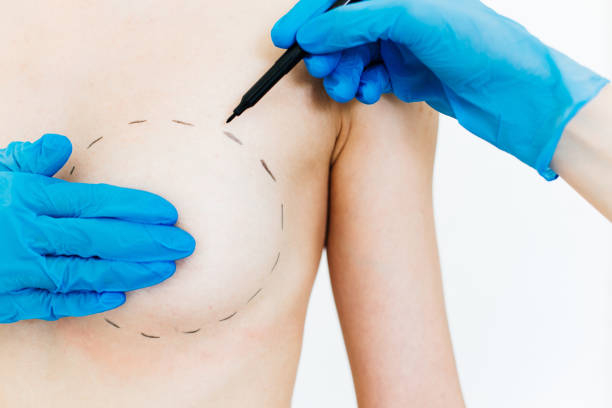
Breast implants are not lifetime devices. Over time, changes in your body, the implants themselves, or your personal aesthetic goals may lead to the need for a revision procedure . (حشوات الثدي السيليكونية في الرياض) Silicone Breast Implants in Riyadh While the prospect of additional surgery can feel daunting, understanding the common scenarios that lead to revision—and what the procedure involves—can help you approach it with confidence. This guide explains the key revision scenarios, the decision-making process, and what to expect, so you can make informed choices about your long-term breast health.
Common Revision Scenarios
Women seek breast implant revision for a variety of reasons. These fall into two broad categories: medical complications and personal preference.
Medical Indications for Revision
Capsular Contracture: This is one of the most common reasons for revision. It occurs when the scar tissue capsule that naturally forms around the implant tightens and hardens, causing firmness, pain, or breast distortion . In severe cases (Baker Grade IV), revision is often recommended . The procedure typically involves removing the scar tissue (capsulectomy) and replacing the implant .
Implant Rupture or Leakage: While modern silicone implants have a low rupture rate (about 10% at 10 years) , rupture can still occur. Silicone ruptures can be "silent"—meaning the gel stays contained and you may not notice symptoms . This is why regular imaging (MRI or ultrasound) is recommended for silicone implants, with a first screening at 5–6 years and every 2–3 years after .
Implant Malposition: Implants can shift out of their original position due to aging, muscle activity, or issues from previous surgeries . This can cause asymmetry, "bottoming out," or a "double bubble" deformity . Revision may involve repositioning the implant or adjusting the pocket .
Pain or Discomfort: Unexplained pain, tenderness, or pressure around the breasts can be a sign of capsular contracture, nerve involvement, or implant movement and warrants a surgical evaluation .
Aesthetic and Personal Preference Revisions
Many women choose revision for reasons unrelated to complications:
-
Changing Implant Size or Type: Preferences evolve over time. Some women wish to go larger or smaller, or switch from saline to silicone, or vice versa .
-
Aging and Tissue Changes: Pregnancy, weight fluctuations, and gravity can alter breast shape over time. A revision may be combined with a breast lift (mastopexy) to restore a more youthful position .
-
Desire for Explantation: Some women choose to have their implants removed entirely without replacement, a decision that will permanently alter the breast appearance .
The Revision Procedure: What to Expect
Breast implant revision is often more complex than the primary augmentation . The surgeon must account for existing scar tissue, altered tissue planes, and your specific goals. The procedure may involve one or more of the following:
-
Implant Exchange: Removing the old implant and replacing it with a new one, possibly of a different size or type .
-
Capsulectomy: Removing the scar tissue capsule around the implant .
-
Pocket Correction: Reshaping or tightening the space where the implant sits to correct malposition .
-
Breast Lift (Mastopexy): Often combined with revision to address sagging and improve breast shape .
Data on Revision Rates and Outcomes
Clinical data provides important context. A 2024 study following a cohort of Motiva implant patients reported a reoperation rate of 6.1% in primary augmentation patients and 25.8% in revisional augmentation patients at 3 years . This highlights that revision surgery, while common, is a more involved undertaking. The leading causes of revision were noted to be malposition and size change, rather than rupture or capsular contracture . A systematic review of revision studies reported a pooled complication rate of 31% for implant exchange revisions .
Regular Monitoring: The Key to Peace of Mind
The most effective way to avoid a complicated revision scenario is early detection. For women with silicone implants, the FDA recommends routine imaging to detect "silent ruptures" that may not cause symptoms . An ultrasound or MRI is recommended 5–6 years after placement, and every 2–3 years thereafter . If a rupture is detected, the implant can be replaced with a simpler procedure before complications develop.
For those seeking expert guidance and customized aesthetic care, you can book an appointment consultation at the 'Enfield Royal Riyadh (إنفيلد رويال الرياض).'
Frequently Asked Questions
How often do silicone breast implants need to be replaced?
There is no set expiration date. While the 10-year rule is a common myth, implants may last 15–20 years or longer. Revision is typically driven by complications or personal preference, not a fixed timeline .
What is the most common reason for breast implant revision?
Capsular contracture (hardening of scar tissue), implant malposition, and a desire to change size or shape are among the most common reasons .
Is a "silent rupture" dangerous?
A silent rupture—where a silicone implant shell breaks without symptoms—is not typically an emergency but does require surgical replacement to avoid potential complications. Regular imaging screenings (MRI or ultrasound) are the only way to detect it .
Can I have my implants removed without replacement?
Yes, this is called explantation. However, it results in a permanent change to the breast's appearance, as the tissue stretched by the implant will lose its volume. A skilled surgeon can help you understand the likely outcome .
Will insurance cover my breast implant revision?
Coverage depends on the reason for surgery. Revision for a ruptured implant may be covered, while purely cosmetic revisions (like changing size) typically are not. Check with your insurance provider and surgeon for specifics .

 English
 French
 Spanish
 Portuguese
 Deutsch
 Turkish
 Dutch
Dutch
 Italiano
 Russian
 Romaian
 Portuguese (Brazil)
 Greek
Greek