
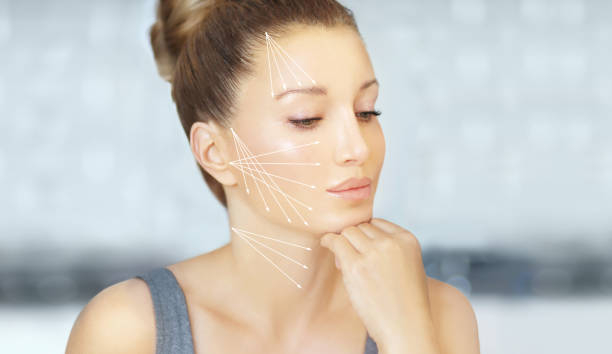
Patients considering a facelift with Silhouette Threads in Dubai often ask the same question: what happens when the threads disappear? The clinical answer is reassuring—the face does not suddenly collapse. The PLLA cones and sutures dissolve gradually over 12 to 18 months, but during this same period, they stimulate the production of new collagen that replaces the mechanical lift with biological support. The primary benefit of this unique mechanism is a smooth transition: the face does not "drop" when the threads are gone because the body has built its own scaffolding.
The Dissolution Timeline
Phase One: The Mechanical Phase (Months 0-6)
During the first six months, the Silhouette Soft threads remain largely intact. The PLLA cones are still anchoring the tissue in its elevated position. The mechanical lift is at its strongest during this phase. The threads are physically holding the descended tissue in place, creating the visible improvement in jawline definition, cheek elevation, and nasolabial fold softening.
At the same time, the body begins to respond to the PLLA material. The presence of the cones triggers a controlled inflammatory response. Fibroblasts migrate to the area and begin laying down new collagen fibers around the thread matrix. This process is slow but steady—the foundation for long-term results is being built while the threads are still doing their mechanical work.
Phase Two: The Transition Phase (Months 6-12)
Between months six and twelve, the PLLA threads begin to hydrolyze. The long polymer chains break down into lactic acid, which is naturally metabolized by the body. The cones lose their structural integrity and eventually disappear. The mechanical lift diminishes.
But this is not a failure—it is the intended design. As the threads dissolve, they release lactic acid, which continues to stimulate collagen production. The collagen matrix that was built during the first six months now takes over the role of tissue support. The face does not drop because the collagen scaffold is now holding the tissue in place.
Phase Three: The Biological Phase (Months 12-24)
By month twelve, the threads are fully dissolved. No PLLA material remains. The lift is now entirely biological—maintained by the collagen matrix that the threads stimulated. This collagen is the patient's own tissue, dense and well-organized, providing support that mimics the natural facial scaffolding of youth.
The result during this phase is often described as "settled." The face looks natural, not lifted artificially. The skin feels thicker and more resilient. The improvement is subtle but durable, and it does not disappear suddenly when the threads are gone.
Data Comparison: Thread Dissolution vs. Other Modalities
Why the Transition Matters
The table below compares how different treatment modalities behave as their active materials degrade or dissolve.
| Parameter | Silhouette Soft (PLLA) | PDO Threads | Hyaluronic Acid Fillers |
|---|---|---|---|
| Dissolution Timeline | 12-18 months | 4-6 months | 12-18 months |
| Mechanism of Action | Mechanical lift + collagen induction | Mechanical lift only | Volume replacement |
| Collagen Stimulation | Significant, sustained | Minimal, transient | Minimal |
| Result After Dissolution | Biological support remains | Lift disappears | Volume disappears |
| Face "Drops" After Dissolution | No (collagen scaffold) | Yes (no biological support) | Yes (volume loss) |
| Longevity of Improvement | 18-24 months | 6-9 months | 12-18 months |
The critical difference is collagen. Silhouette Soft threads are designed to leave behind a biological legacy. PDO threads and fillers do not.
Clinical Protocol: Managing the Transition
What Patients Experience at Month 8
At Tajmeels Clinic, patients are prepared for the transition phase from the outset. Around month eight, some patients report a sensation that the lift is "softening." They may notice that the tight feeling has completely resolved, and the face feels more natural. This is expected—it is the mechanical lift giving way to the biological support.
What patients do not experience is a sudden drop. The transition is gradual. The face does not sag overnight. Instead, the improvement evolves from a taut, lifted appearance to a softer, more natural-looking elevation. This is why many patients report that their result looks better at month twelve than it did at month three.
"I was worried that when the threads dissolved, my face would go back to how it was. It didn't. The lift softened slightly, but my skin felt thicker and more supported. It's been two years now, and I still see the improvement."
— Fatima S., Umm Suqeim
The Maintenance Window
The transition phase is the ideal time to schedule a maintenance session. At month twelve, the patient returns for an assessment. The practitioner evaluates the degree of residual lift and the quality of the collagen matrix. If the patient desires additional correction, a smaller number of threads can be placed to reinforce the existing support.
This proactive approach prevents the face from returning to its pre-treatment state. By scheduling maintenance before the biological support fully degrades, the patient maintains a continuous improvement rather than cycling through periods of correction and relapse.
"My doctor told me to come back at the one-year mark, even if I thought I didn't need it. I did, and he placed two threads per side instead of four. The result never went away—it just kept getting better."
— Noura M., Dubai Marina
Expected Results and Maintenance
The Long-Term Collagen Dividend
The collagen produced in response to Silhouette threads is not permanent—it degrades over time, just like natural collagen. However, the rate of degradation is slow. Even after the threads are fully dissolved, the collagen matrix provides support for an additional 6 to 12 months. This is why the total longevity of a facelift with Silhouette Threads in Dubai is often cited as 18 to 24 months, not just 12.
For patients who commit to good skincare—daily SPF, topical retinoids, and adequate hydration—the collagen may last longer. Patients who smoke, skip sun protection, or have poor nutrition will see faster collagen degradation.
For those seeking the most durable clinical outcome, opting for a professional Facelift with Silhouette Threads in Dubai at a center that provides structured maintenance planning guarantees a result that endures beyond the initial treatment.
The Strategic Investment
Why the Dissolution Process Is the Product
The genius of Silhouette Soft threads is not the threads themselves—it is the collagen they leave behind. The threads are a catalyst, not a permanent implant. The real treatment is the biological remodeling that occurs over 12 to 18 months. This is why patients who understand the process are more satisfied: they know that the result is not dependent on a foreign material but on their own body's response.
The Dubai Context
Dubai patients are sophisticated. They ask intelligent questions about longevity and maintenance. Tajmeels Clinic understands that transparency about the dissolution process builds trust. The goal is not to sell threads—it is to educate patients about how their body will respond and to provide a maintenance plan that sustains the result.
Frequently Asked Questions
1. Will my face sag when the Silhouette threads dissolve?
No. The threads dissolve gradually over 12-18 months while simultaneously stimulating collagen production. By the time the threads are fully dissolved, the collagen matrix has taken over the supportive role. The face does not experience a sudden drop.
2. How long does it take for Silhouette threads to fully dissolve?
The PLLA threads typically dissolve completely within 12 to 18 months. The exact timeline varies by patient metabolism, thread thickness, and the number of threads placed. The dissolution is gradual, not sudden.
3. What is the collagen left behind after the threads dissolve?
The collagen is your own body's tissue—dense, well-organized fibers that provide structural support to the skin. It mimics the natural facial scaffolding of youth. This collagen degrades slowly over time, typically over an additional 6 to 12 months after the threads are gone.
4. Can I get new threads placed before the old ones dissolve?
Yes. Many patients schedule maintenance at the 12-month mark, before the threads are fully dissolved. This allows the practitioner to place a smaller number of new threads to reinforce the existing collagen support. The result is a continuous improvement without regression.
5. Why do some people say thread lifts don't last?
Those reports typically refer to PDO threads, which dissolve in 4-6 months without significant collagen stimulation. Silhouette Soft threads are fundamentally different—they use PLLA cones that stimulate collagen for up to 12 months, extending the result to 18-24 months.
6. How will I know when to schedule maintenance?
Your practitioner will advise a follow-up timeline. Typically, a maintenance assessment is scheduled at 12 months. At this visit, the practitioner evaluates the residual lift and collagen quality. If needed, a touch-up session with fewer threads can be performed to sustain the result.

 English
 Arabic
 French
 Spanish
 Portuguese
 Turkish
 Dutch
Dutch
 Italiano
 Russian
 Romaian
 Portuguese (Brazil)
 Greek
Greek