
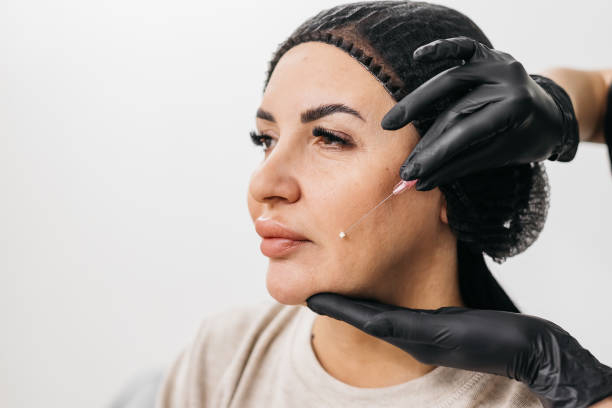
A V-shaped face typically has a narrower lower face that gradually widens toward the cheekbones. Jawline Filler Injections in Dubai may help create a more V-shaped appearance in selected patients by improving chin projection, refining the mandibular contour, and creating better visual relationships between the chin and jaw. However, filler does not physically narrow the bones or remove facial fat, so the result depends heavily on the patient's existing anatomy.
The objective is not simply to make the jaw smaller. Instead, strategic enhancement of selected structures can change how the lower face is perceived.
What Is a V-Shaped Face?
A V-shaped face generally appears narrower toward the chin and broader through the cheekbone region.
The appearance can be influenced by several anatomical characteristics, including:
- Chin projection
- Mandibular width
- Jaw angle
- Cheekbone prominence
- Facial fat distribution
- Masseter muscle size
- Skin and soft-tissue volume
- Overall facial proportions
This means two people can have the same jawline filler treatment but develop very different visual results.
A patient with a naturally narrow lower face may need only subtle definition. Someone with a broad mandibular structure may not achieve a V-shaped appearance through filler alone.
How Can Jawline Filler Create a V-Shaped Appearance?
Filler does not directly “make the face V-shaped.” Instead, it can modify specific proportions that influence the visual shape of the lower face.
For example, increasing chin projection can make the lower face appear more tapered when viewed from the front or three-quarter angle.
Similarly, carefully defining selected portions of the mandibular border can create a cleaner transition between the chin, jaw, and neck.
The treatment may focus on:
- Chin-to-jaw proportion
- Anterior jawline definition
- Selected mandibular contour
- Prejowl transition
- Facial symmetry
- Overall lower-face proportions
Research on HA fillers for jawline definition has demonstrated measurable improvements in jawline contour and patient satisfaction in appropriately selected patients.
Can Jawline Filler Make a Wide Face Look Narrower?
This depends on why the face appears wide.
If width is primarily related to poor definition, soft-tissue distribution, or a relatively weak chin, strategic contour enhancement may make the face appear more tapered.
But filler can also add width.
If a patient already has a broad lower face and significant mandibular width, adding substantial filler along the jaw may produce a stronger or wider appearance rather than a V shape.
This is why “more jawline filler” is not synonymous with “more facial slimming.”
A proper consultation should identify the actual source of facial width before treatment is selected.
The Chin Is Often Important to a V-Shaped Appearance
The chin can have a major influence on lower-face geometry.
A relatively short or recessed chin can make the lower face look broader because there is less forward projection at its lowest point.
In selected patients, chin filler may increase projection and create a more tapered visual relationship between the chin and jaw.
This does not mean everyone seeking a V-shaped face needs chin filler.
The clinician may determine that the existing chin is already appropriately projected and that the primary concern is mandibular contour.
The important principle is to treat the proportion rather than chase a particular facial shape.
Jawline Filler Injections in Dubai and Facial Proportion
A V-shaped appearance should still look natural from different angles.
A treatment that looks narrow from the front but excessively projected from the side may create a new imbalance.
For this reason, assessment may include:
- Front-facing analysis
- Side-profile analysis
- Three-quarter views
- Chin projection
- Jaw width
- Jaw angle
- Cheek-to-jaw relationship
- Chin-to-neck transition
- Facial symmetry
Modern filler planning increasingly emphasizes individualized anatomical assessment rather than applying identical injection patterns to every patient. Studies of jawline HA filler have evaluated outcomes across different skin types, genders, and ages, reinforcing the importance of individualized treatment planning.
V-Shaped Face vs Sharp Jawline: They Are Not the Same
These concepts are often used interchangeably, but they are different.
| Goal | Main visual objective | Role of filler |
|---|---|---|
| Sharp jawline | Stronger mandibular definition | May provide structural contour |
| V-shaped face | More tapered lower-face appearance | May balance chin and jaw proportions |
| Stronger chin | Increased projection or definition | Chin-focused filler may help |
| Slimmer-looking face | Reduced perception of lower-face width | Depends on the cause of width |
| Better profile | Improved side-view proportions | Chin and jaw may be assessed together |
| Smoother prejowl | Improved transition near the chin | Selected filler placement may help |
A patient can have a very sharp jawline without having a V-shaped face.
Conversely, someone can have a relatively soft jawline but still have a naturally tapered lower face.
Who May Be a Better Candidate?
Jawline filler may be considered when the desired V-shaped appearance can be created through subtle changes in facial proportion.
Potentially suitable concerns include:
- Mildly recessed chin
- Lack of lower-face definition
- Subtle contour irregularities
- Prejowl volume deficiency
- Mild asymmetry
- Weak visual transition between chin and jaw
- Loss of definition associated with facial volume changes
The treatment may be less suitable when the primary concern is substantial facial fat, pronounced muscle bulk, significant skin laxity, or skeletal width.
A recent prospective study evaluated HA filler in patients with chin retrusion and/or loss of jawline contour and found improvements in measured facial contour following individualized treatment, although the study was relatively small and should not be interpreted as proof that filler can produce the same result in every patient.
What If Facial Width Comes From Masseter Muscles?
The masseter muscles are located near the angle of the jaw and contribute to lower-face width.
If a patient's face appears broad because of prominent masseter muscles, adding jawline filler may not address the underlying reason for the width.
This is an important distinction during consultation.
The clinician may need to determine whether the dominant contributor is:
- Bone structure
- Muscle bulk
- Fat
- Skin laxity
- Soft-tissue volume
- Lack of chin projection
Different causes require different treatment strategies.
What If Facial Width Comes From Submental Fat?
Excess fat beneath the chin can blur the jawline and make the lower face appear wider or less defined.
In this situation, filler alone may not be the most appropriate first approach.
Research has investigated combining fat-reduction treatment with HA filler in selected patients with submental fullness and poor jawline definition, suggesting that addressing both soft-tissue fullness and structural contour can be useful in appropriate cases.
The important point is that filler should not be used as a substitute for treating a fundamentally different problem.
Can Jawline Filler Produce a Permanent V-Shaped Face?
Most commonly used dermal fillers are temporary and are gradually absorbed by the body.
The duration of an effect depends on the filler material, treatment area, and individual factors.
Therefore, patients should think of jawline filler as a temporary aesthetic modification rather than permanent facial restructuring.
This can also be an advantage for patients who want to assess how a new facial proportion suits them before considering more permanent interventions.
What Happens During Treatment?
A well-planned appointment begins with assessment rather than immediate injection.
The clinician may:
- Discuss the patient's aesthetic objective.
- Examine the face from multiple angles.
- Identify the structures responsible for the current appearance.
- Determine whether the chin, jaw, or both should be treated.
- Select an appropriate filler based on the intended correction.
- Map treatment areas.
- Inject conservatively according to the treatment plan.
- Provide individualized aftercare instructions.
The exact technique varies because facial anatomy differs significantly between individuals.
FDA guidance emphasizes that dermal filler injection is a medical procedure and should be performed by a licensed healthcare professional with appropriate training and knowledge of facial anatomy.
What Results Should You Realistically Expect?
A realistic goal is usually improved proportion and definition rather than a completely different face shape.
Potential changes may include:
- More defined chin
- Cleaner jawline
- Better lower-face taper
- Improved three-quarter appearance
- Smoother prejowl transition
- Greater facial symmetry
- More defined chin-to-neck relationship
The final appearance depends on the patient's starting anatomy and the amount and placement of filler.
A provider should be able to explain what filler can realistically change before treatment begins.
Recovery and Dubai Lifestyle Considerations
Temporary swelling, bruising, redness, tenderness, or pain can occur after dermal filler treatment. Many common reactions resolve within days to weeks, although recovery differs between patients.
For patients in Dubai, recovery planning may need to account for:
- Strong outdoor sunlight
- High temperatures
- Outdoor exercise
- Beach or pool activities
- Weddings and social events
- Professional photography
- International travel
- Frequent movement between outdoor heat and indoor air conditioning
Patients should follow the specific aftercare instructions provided by their healthcare professional rather than relying on generic recovery timelines.
Is Creating a V-Shaped Face With Filler Safe?
Like all medical procedures, dermal filler carries potential risks.
Common temporary reactions include swelling, bruising, redness, pain, tenderness, itching, and rash. More serious complications can occur if filler unintentionally enters a blood vessel. These may include tissue necrosis, vision abnormalities including blindness, and stroke.
Patients should seek urgent medical attention for unusual or severe pain, skin that becomes white, gray, or blue near the injection site, vision changes, or symptoms associated with stroke.
The safest approach is to choose a qualified medical provider who understands facial anatomy and has appropriate emergency protocols.
Questions to Ask Before Treatment
Before booking, consider asking:
- Is my face naturally suited to a V-shaped appearance?
- Is my facial width caused by bone, muscle, fat, or soft tissue?
- Would chin filler or jawline filler better address my proportions?
- Would treating both areas create better balance?
- Could additional jawline filler make my face look wider?
- What degree of change is realistically possible?
- Which filler is being recommended and why?
- What are the expected temporary side effects?
- What warning signs require urgent attention?
- Would another treatment be more appropriate for my anatomy?
These questions can help prevent unrealistic expectations and unnecessary filler volume.
Is a V-Shaped Face Right for Everyone?
Not necessarily.
Facial aesthetics are influenced by individual anatomy, age, gender, cultural preferences, and personal expectations. A strong V-shaped appearance may suit one person's facial structure but look disproportionate on another.
The goal should therefore be individualized facial harmony.
For patients researching V-shaped facial contouring and jawline treatment in Dubai, the focus should be on creating a proportion that complements the entire face rather than copying a specific facial shape.
The Strategic Investment
Jawline Filler Injections in Dubai can contribute to a more V-shaped appearance when the underlying concern involves treatable contour or proportion issues. The best candidates are those whose facial anatomy allows subtle enhancement of the chin, jawline, or prejowl region without creating excessive lower-face width.
A professional assessment is essential because filler cannot narrow bone, remove substantial fat, or replace a surgical correction when structural changes are significant. The most natural result comes from choosing the right target, using appropriate volume, and preserving the proportions that already make the face distinctive.

 English
 Arabic
 French
 Spanish
 Portuguese
 Turkish
 Dutch
Dutch
 Italiano
 Russian
 Romaian
 Portuguese (Brazil)
 Greek
Greek