
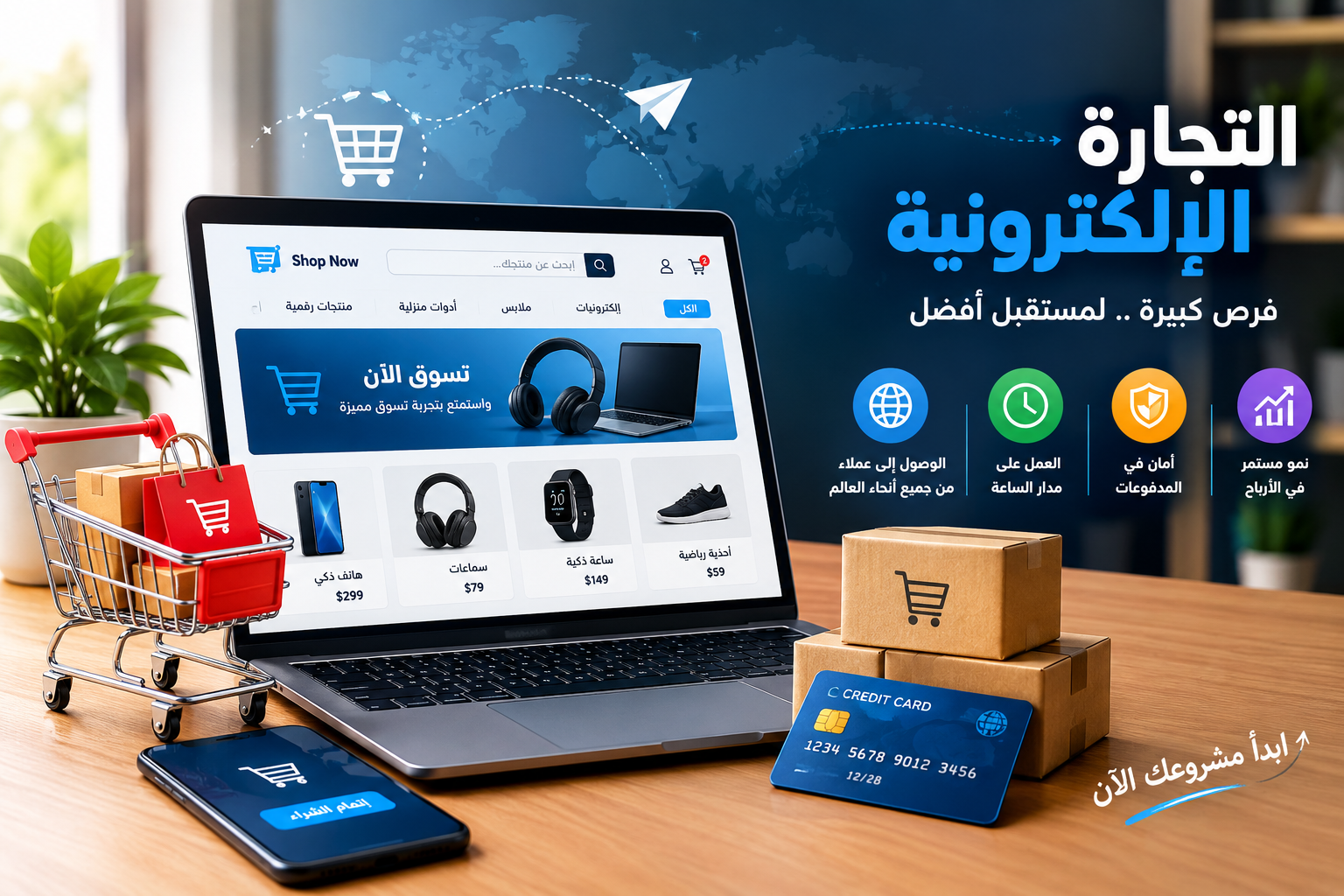
E-commerce: How to Start an Online Business and Make Your First Sale Have you ever considered starting your own business without the need to rent a physical store or incur high operating costs? Today, e-commerce has become one of the most important ways to launch a new venture and reach customers worldwide; all you need is a solid idea, a suitable product, and a clear strategy. In this article, we will explore the concept of e-commerce, how to get started, and the key steps to building a successful online store. What Is E-commerce? E-commerce is the process of buying and selling products or services online. It has evolved significantly in recent years; online stores are no longer limited to selling clothing or electronics. Now, it is possible to sell digital products, software, designs, educational courses, e-books, and much more. One of the major advantages of e-commerce is the ability to reach a vast number of customers without needing a traditional brick-and-mortar store. Why Is E-commerce a Significant Opportunity? There are many reasons why e-commerce is an attractive option for entrepreneurs, including: The ability to start a business with lower costs compared to a traditional store. Access to customers around the clock. The ability to sell products both locally and globally. The ease of showcasing a wide range of products. Opportunities for marketing via search engines and social media. The ability to analyze customer behavior and improve products and services. However, success in e-commerce goes beyond simply setting up a store; it requires planning, building trust, and delivering an excellent customer experience. How do you start an e-commerce business? 1. Choose a suitable business idea The first step is selecting the field you want to work in. Try to identify a problem people need solved or a product customers are constantly seeking. You can sell products such as: Clothing, accessories, household goods, appliances, educational products, designs, software, code, and digital products. It is best to start with a specific niche rather than trying to sell everything at once. 2. Know your audience Before setting up the store, ask yourself: Who are the customers I want to reach? What do they need? How much can they afford to pay? Where do they look for products? The better you understand your audience, the easier it becomes to create products, offers, and marketing strategies tailored to them. 3. Build a professional store Your online store is the face of your business; therefore, it must be fast, user-friendly, and mobile-compatible. Ensure you include: A simple, professional design. Clear product images. Detailed, compelling descriptions. Clear pricing. A contact page. A privacy policy. Terms of use and return policies (where applicable). Payment and shipping methods suited to your business. Don't forget that many visitors access stores via mobile phones, so the store must be responsive across all screen sizes. Digital products: A unique opportunity in e-commerce If you prefer not to deal with inventory storage and shipping, digital products might be a suitable option. Many digital products can be sold online, such as: Ready-made templates. Code snippets. E-books. Designs. Educational files. Images and graphics. Digital courses. Tools and resources for developers and designers. A key advantage of digital products is that a single product can be sold to a vast number of customers without the need for storage or shipping for each transaction. How do you attract customers to your store? Creating a beautiful store isn't enough on its own; people need to know your store exists. This is where digital marketing comes into play. You can leverage search engines by writing useful articles that target keywords your audience is searching for. You can also utilize social media to share educational, valuable content related to your products. For example, if you sell ready-made code snippets, you could write articles such as: "The Best Code Snippets Every Beginner Developer Needs" Or: "How to Save Time Using Ready-Made Code Snippets?" Then, naturally guide the reader toward the relevant products in your store. Don't focus solely on sales. A common mistake is making your store's content consist entirely of product advertisements. Visitors primarily look for information and value; if they find useful, trustworthy content on your blog, they are likely to return. Therefore, aim to build a blog featuring educational articles and solutions to the problems and questions that matter to your audience. In this way, the blog can become a consistent source of traffic for your store. Building trust is more important than the initial visit. Someone might visit your store for the first time without making a purchase—and that is perfectly normal. The key is for the customer to find reasons to trust you, such as: Clear information about the store. Honest product descriptions. Real or appropriate product photos. A clear return policy (where applicable). Effective communication channels. Customer reviews and ratings (when available). Customer data protection. Trust is one of the most important factors in converting a visitor into a customer. Do you need significant capital? Not necessarily. Costs vary depending on the type of business, the products, and the platform used. Some ventures can start with limited investment, especially those based on digital products or services. However, do not make low cost your sole objective. The most important thing is to offer a useful product that solves a real problem and is worth the price the customer pays. The Future of E-commerce E-commerce is no longer just an additional sales channel; it has become an integral part of the modern business world. With the growing use of mobile phones and the internet, business owners can now reach customers who were previously inaccessible. However, competition has also intensified. Success therefore requires continuous store development, improved user experience, a deep understanding of customers, and the delivery of value.


 English
 Arabic
 French
 Spanish
 Portuguese
 Deutsch
 Turkish
 Italiano
 Russian
 Romaian
 Portuguese (Brazil)
 Greek
Greek