
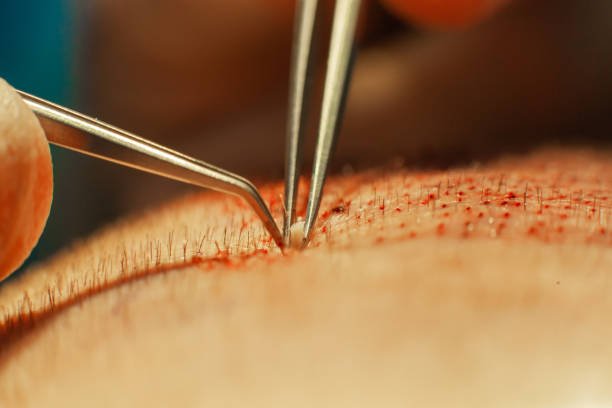
A widow's peak is a natural V-shaped point at the center of the frontal hairline, but its appearance can change when surrounding density decreases. DHI Direct Hair Implant in Dubai may be considered when patients want to address uneven density around a prominent widow's peak while preserving a balanced frontal contour.
The goal is not necessarily to remove the widow's peak. In many cases, the more important issue is how the central point connects visually with the surrounding frontal hair and temples.
Understanding the Shape of a Widow's Peak
A widow's peak is created by the natural position and distribution of follicles along the frontal scalp.
For some people, it is a subtle feature. For others, the central point is more pronounced because the surrounding hairline sits higher or has become thinner over time.
Natural Shape Versus Recession
A prominent central point does not automatically indicate hair loss.
The clinician needs to distinguish a naturally shaped hairline from one where recession has changed the surrounding contour.
Why the Temples Matter
The visual appearance of a widow's peak is influenced by the temples.
If the temporal areas have receded while the central point remains relatively stable, the contrast can make the V shape appear more pronounced than it previously did.
DHI Direct Hair Implant in Dubai for Frontal Contour
DHI can be considered when additional follicles are needed in selected frontal areas.
The treatment can be planned around the existing hair rather than automatically redesigning the entire hairline.
Connecting the Central Point With Existing Hair
A successful frontal design needs a gradual transition.
The clinician may place selected grafts around areas of reduced density so that the central peak blends more naturally into the surrounding frontal region.
Avoiding an Artificial Straight Line
Trying to completely eliminate a natural widow's peak by creating a rigid horizontal hairline can produce an unnatural appearance.
The treatment plan should consider the patient's existing facial proportions and hair-growth pattern.
Why Graft Placement Matters
The frontal scalp is highly visible.
Hair direction, angle, spacing, and follicular-unit selection can influence how the reconstructed area appears from different distances and lighting conditions.
Single-Hair Units at the Frontal Edge
Single-hair follicular units can be useful when a softer transition is required.
Larger follicular units may be positioned farther behind the frontal boundary when additional density is appropriate.
Following Existing Growth Direction
Hair does not emerge from the scalp at one universal angle.
The recipient sites should be planned around the surrounding growth pattern so that newly implanted follicles integrate visually with existing hair.
DHI Direct Hair Implant in Dubai and Facial Balance
Hairline design is also a facial-proportion decision.
The forehead, eyebrows, temples, and overall facial structure contribute to how the frontal hairline is perceived.
Why Lower Is Not Always Better
Moving the hairline downward simply to reduce visible forehead area can consume donor follicles without necessarily improving facial balance.
A more conservative adjustment may sometimes provide a better relationship between the forehead and the rest of the face.
Common Patient Questions
“Can DHI completely remove a widow's peak?”
It may be possible to modify the appearance of a widow's peak in selected cases, but complete removal is not always necessary or advisable.
The clinician may recommend preserving some of the natural contour to maintain a realistic appearance.
“Can only one side of the widow's peak be treated?”
Treatment can be planned for localized areas when the asymmetry is clinically suitable for transplantation.
The decision depends on donor availability and the condition of the surrounding follicles.
“Will the new follicles look different from my existing hair?”
The objective is to select and position suitable grafts so that they integrate with the surrounding hair. Hair calibre, texture, direction, and follicular-unit characteristics all influence the final appearance.
Treatment Roadmap for DHI Direct Hair Implant in Dubai
- Frontal hairline assessment
The clinician examines the central peak, temples, surrounding density, and existing follicular direction.
- Facial-proportion analysis
The proposed design is considered in relation to the forehead and overall facial structure.
- Donor evaluation
Available follicular units are assessed before determining how much restoration is practical.
- Frontal mapping
The areas requiring additional density are mapped without unnecessarily changing stable hairline structures.
- DHI implantation
Selected grafts are positioned according to the planned angle, direction, and distribution.
- Progressive maturation
The transplanted follicles develop gradually, with the final appearance becoming clearer as the hair matures.
Planning a Natural Frontal Contour
A widow's peak can be part of an individual's natural facial identity.
For that reason, DHI planning should not automatically aim to erase the feature. A more precise approach may focus on improving surrounding density and creating better continuity between the central point and the rest of the hairline.
For individualized assessment and treatment planning, patients can explore Tajmeels Clinic and discuss their frontal hairline, donor supply, and desired outcome.

 English
 Arabic
 French
 Spanish
 Portuguese
 Deutsch
 Turkish
 Italiano
 Russian
 Romaian
 Portuguese (Brazil)
 Greek
Greek