
INTRODUCTION
Choosing the right ventilation system is one of the most important decisions in IVF Lab Design, because laboratory air quality can influence the controlled environment in which eggs, sperm, and embryos are handled. Unlike conventional office or general laboratory ventilation, an IVF laboratory requires carefully planned heating, ventilation, and air conditioning (HVAC), high-efficiency particulate air (HEPA) filtration, chemical filtration, pressure control, and continuous environmental monitoring. These systems help control airborne particles, volatile organic compounds (VOCs), temperature, and humidity while supporting a consistent laboratory workflow.
A well-designed ventilation system should be developed around the clinic’s procedures, room layout, equipment, local climate, and applicable regulations. The aim is not simply to move air through the laboratory, but to manage air cleanliness and environmental stability without creating disruptive drafts or exposing reproductive cells and tissues to avoidable contaminants. The 2026 European Society of Human Reproduction and Embryology (ESHRE) recommendations emphasize HEPA filtration, VOC control, positive pressure, sufficient fresh-air supply, and regular monitoring of laboratory air quality. <Cite refs={["turn618193search0","turn618193search1"]}/>
Why Is Ventilation Important in an IVF Laboratory?
An IVF laboratory contains sensitive work areas where reproductive cells are processed and embryos may be cultured. Airborne particles, chemical contaminants, unsuitable temperature conditions, and inconsistent humidity can undermine the controlled environment required for these activities.
A properly engineered ventilation system helps the clinic:
-
Control airborne particles and other contaminants.
-
Reduce the entry of less-clean air from adjoining rooms.
-
Manage VOCs released by construction materials, furnishings, cleaning products, and equipment.
-
Maintain stable temperature and humidity.
-
Support suitable air movement around laboratory workstations.
-
Provide measurable conditions that can be checked during routine quality assurance.
-
Improve staff comfort and support efficient laboratory workflows.
Ventilation is only one part of laboratory quality. Good housekeeping, suitable low-emission materials, equipment maintenance, controlled access, and validated laboratory procedures must work together with the HVAC system.
1. Dedicated HVAC System
A dedicated HVAC system is a recommended option for IVF laboratory environments because it allows the facility to manage air supply, temperature, humidity, filtration, and pressure according to the laboratory’s needs. Sharing an air system with unrelated spaces may make environmental control more difficult, depending on the building layout and system design.
A suitable HVAC system should include:
-
Air-handling equipment selected for the laboratory’s required airflow.
-
Heating and cooling controls.
-
Humidity regulation.
-
Appropriate fresh-air supply and filtered-air recirculation.
-
Compatible particulate and chemical filtration stages.
-
Differential-pressure monitoring.
-
Access for inspection, filter replacement, and maintenance.
The system should be designed by professionals familiar with assisted reproductive technology laboratories. It should also account for heat generated by incubators, laboratory equipment, lighting, and the number of staff working in the space.
2. HEPA Filtration
High-efficiency particulate air filtration is a key component of IVF laboratory ventilation. HEPA filters remove airborne particles from the air passing through them, helping reduce particulate contamination in controlled work areas.
A filtration design should consider:
-
Filter efficiency appropriate to the room’s risk assessment and design specification.
-
Filter placement, including whether terminal filtration is appropriate.
-
Sealed housings and duct connections to prevent air bypass.
-
Access for safe inspection and replacement.
-
Filter integrity testing and documentation.
-
Monitoring of pressure drop across filters where applicable.
HEPA filtration does not remove every gaseous chemical contaminant. It should therefore be combined with suitable chemical filtration where needed. The filter class and airflow arrangement should be specified by the project’s qualified design team rather than selected solely by a product label. ESHRE’s 2026 recommendations identify HEPA filtration as part of the approach to controlling IVF laboratory air quality. <Cite refs={["turn618193search0","turn618193search1"]}/>
3. VOC and Chemical Filtration
Volatile organic compounds can be released by paints, adhesives, sealants, flooring, furniture, cleaning products, and some equipment. Certain airborne chemical contaminants are a particular concern in IVF environments, making chemical filtration an important consideration in addition to particle filtration.
Depending on the contaminant profile and engineering design, the HVAC system may incorporate activated carbon or other appropriate gas-phase filtration media. Selection should account for the compounds expected, airflow rate, filter capacity, contact time, and replacement requirements.
Important design considerations include:
-
Choosing low-emission construction and finishing materials.
-
Selecting chemical filters based on the expected contaminants.
-
Ensuring air does not bypass the filter media.
-
Establishing a documented filter replacement schedule.
-
Reviewing possible contamination sources within and outside the facility.
-
Monitoring trends in air quality where appropriate.
Chemical filtration is not a substitute for controlling pollution at its source. Low-VOC materials and suitable cleaning practices should be included from the planning stage. The Cairo consensus on IVF laboratory air quality and the updated ESHRE recommendations both highlight the importance of controlling VOCs. <Cite refs={["turn618193search5","turn618193search6","turn618193search0"]}/>
4. Positive Pressure Ventilation
Positive pressure helps reduce the movement of less-clean air from adjacent areas into the IVF laboratory. It is generally achieved by supplying more filtered air to a space than is removed, while controlling leakage and the pressure relationships between connected rooms.
A pressure cascade may be planned across the laboratory suite, with cleaner critical areas maintained at a higher pressure than less-clean adjoining spaces. The actual pressure differentials should be established by the design engineer based on the layout, applicable guidance, door operation, and required airflow.
A reliable system should provide:
-
Differential-pressure sensors or gauges at relevant room boundaries.
-
Clearly documented pressure targets.
-
Alarms or notifications for significant deviations, where specified.
-
Door and transfer arrangements that limit uncontrolled air exchange.
-
Commissioning tests and routine verification.
Positive pressure alone does not guarantee suitable air quality. It must operate alongside appropriate filtration, adequate airflow, effective room sealing, and maintenance. ESHRE’s 2026 guidance recommends positive pressure to help minimize contamination. <Cite refs={["turn618193search0","turn618193search1"]}/>
5. Controlled Fresh Air and Recirculation
An IVF laboratory needs a carefully designed balance between outdoor fresh air and recirculated, treated air. Fresh air helps meet ventilation requirements, while recirculation can support environmental stability and allow filtered air to be reused efficiently.
The appropriate balance depends on the facility’s occupancy, contaminants, HVAC configuration, local climate, and the performance of its filtration system. The designer should not assume that maximizing outdoor air is always best, because incoming air may itself contain pollutants that require treatment.
The ventilation plan should specify:
-
The required fresh-air supply.
-
The proportion and treatment of recirculated air.
-
Outdoor-air intake locations away from pollution sources.
-
Airflow paths through the laboratory suite.
-
Procedures for unusual outdoor pollution events, if relevant.
-
Verification that the system maintains its required pressure relationships.
The Cairo consensus discusses the use of filtered recirculation and careful isolation of outdoor contaminants as part of IVF laboratory air-quality planning. <Cite refs={["turn618193search5","turn618193search6"]}/>
6. Air Changes and Air Distribution
Air changes per hour (ACH) describe how much air is supplied to a room relative to its volume over one hour. ACH is an important design parameter, but it should not be treated as a standalone guarantee of cleanliness. The result also depends on filter performance, room leakage, airflow distribution, contamination sources, and how the laboratory is used.
Some ART laboratory guidance has referenced approximately 12–15 ACH, while other design specifications may call for different values. These figures should be treated as design references, not universal requirements for every IVF laboratory. The engineering team should establish the appropriate airflow through a documented, risk-based design and applicable local requirements. <Cite refs={["turn618193search2","turn618193search3"]}/>
Air distribution should avoid drafts that interfere with staff or sensitive equipment. Supply diffusers and return grilles need to be positioned so that airflow supports the intended clean environment without creating disruptive currents around critical workstations. The final arrangement should be verified during commissioning.
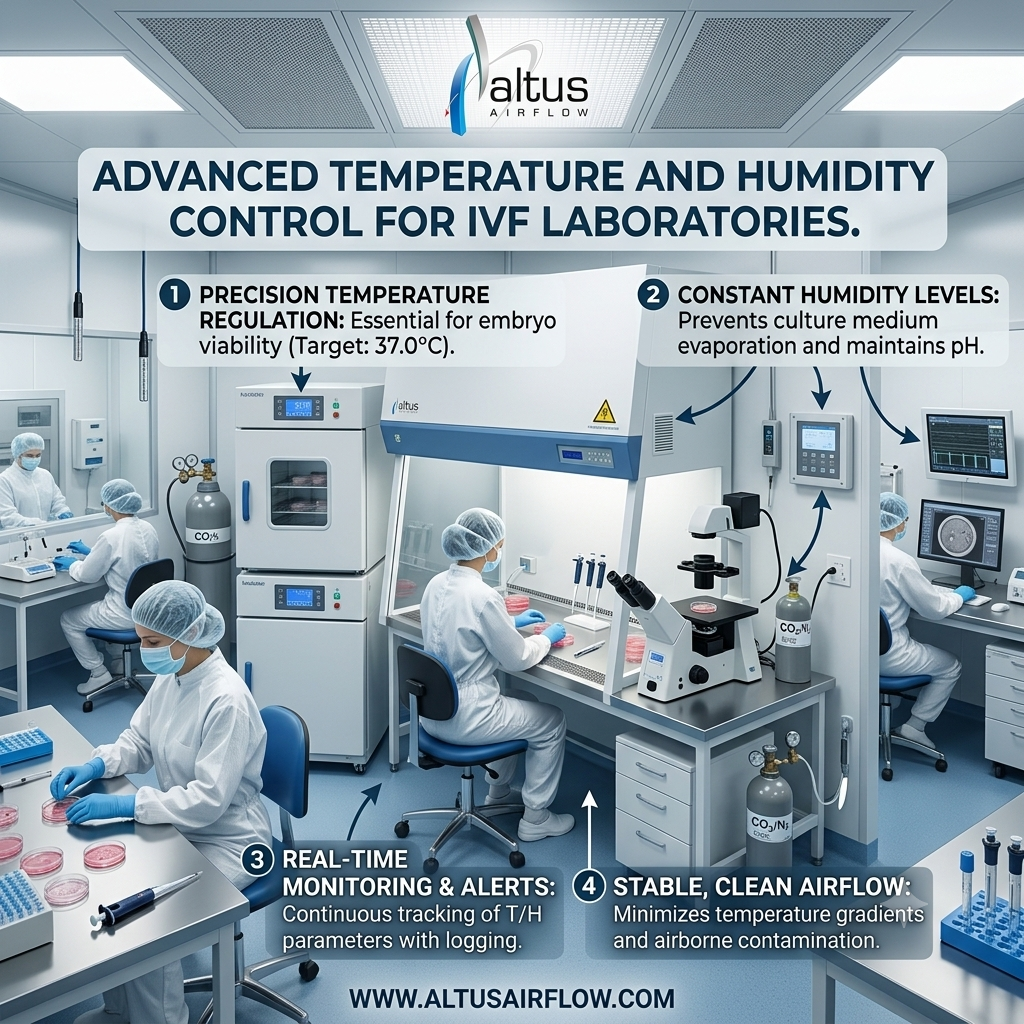
7. Temperature and Humidity Control
Ventilation and air conditioning should maintain environmental conditions suitable for the laboratory’s activities and equipment. Temperature and relative humidity targets must be selected according to the laboratory’s validated operating requirements, local standards, and equipment specifications.
An effective system should provide:
-
Accurate temperature control.
-
Humidity monitoring and regulation.
-
Sensors positioned to give representative readings.
-
Alarm limits and a response procedure for deviations.
-
Routine calibration of monitoring instruments.
-
Documentation of environmental trends.
Room conditions should be distinguished from the temperature requirements of culture media, incubators, and reproductive cells during handling. These may require their own local controls. ESHRE recommends air-conditioning with controlled temperature and humidity and stresses that measured parameters should be monitored and verified with suitable instruments. <Cite refs={["turn618193search0","turn618193search1"]}/>
8. Environmental Monitoring and Building Management Systems
Monitoring helps staff identify changes before they become persistent operational problems. A building management system (BMS) or dedicated environmental monitoring platform can display key parameters and record deviations.
Depending on the risk assessment, monitoring may include:
-
Room temperature and relative humidity.
-
Differential pressure between rooms.
-
Filter pressure drop.
-
HVAC operating status and alarms.
-
Particle counts and periodic air-quality assessments.
-
VOC trends, where applicable.
Monitoring systems should have defined alert limits, documented response procedures, and suitable backup arrangements for critical alarms. The team should review trends rather than relying only on occasional readings. ESHRE recommends regular monitoring of air quality and risk-based assessment of laboratory cleanliness in both ‘at rest’ and ‘in operation’ conditions. <Cite refs={["turn618193search0","turn618193search1"]}/>
9. Separate Ventilation for Cryostorage Areas
Cryostorage rooms require specific safety planning because liquid nitrogen can displace oxygen if released in sufficient quantities. These areas should be assessed separately from the main embryology laboratory.
Depending on the cryostorage system and applicable safety requirements, provisions may include:
-
Dedicated or suitably designed forced ventilation.
-
Oxygen-deficiency monitoring.
-
Audible and visible alarms near access points.
-
Ventilation response linked to low-oxygen alarms where required.
-
Restricted access and staff training.
-
Continuous monitoring of critical storage equipment.
The ventilation and alarm design must be based on the quantity of liquid nitrogen, room geometry, equipment arrangement, and applicable occupational-safety requirements. The 2026 ESHRE recommendations specifically address ventilation and low-oxygen alarms for cryostorage facilities. <Cite refs={["turn618193search0","turn618193search1"]}/>
10. Commissioning, Validation, and Preventive Maintenance
Even a well-selected HVAC system needs to be tested after installation. Commissioning confirms that the system performs as intended and provides a baseline for future maintenance.
Before the laboratory is put into clinical use, the project team should establish and document appropriate checks, such as:
-
Airflow and air-distribution measurements.
-
Differential-pressure verification.
-
Temperature and humidity checks.
-
HEPA filter integrity testing, where applicable.
-
Particle-count or other air-cleanliness assessments based on risk.
-
Verification of monitoring instruments and alarms.
-
Review of chemical filtration and maintenance arrangements.
-
Corrective action for any results outside specified limits.
Routine maintenance should include filter inspections and replacement, cleaning of relevant HVAC components, sensor calibration, review of alarm records, and documented performance checks. Construction materials should also be allowed to off-gas appropriately before the laboratory begins operation, as recommended in IVF laboratory guidance. <Cite refs={["turn618193search5","turn618193search0"]}/>
How to Select the Right Ventilation Solution
When planning a new facility or upgrading an existing one, clinic owners should assess the proposed ventilation design against the actual work performed in the laboratory. A supplier should be able to explain how its system controls particles, chemical contaminants, pressure, temperature, and humidity—and how each parameter will be tested and maintained.
Before approving a proposal, ask for:
-
A room-by-room ventilation and pressure strategy.
-
Specifications for HEPA and gas-phase filtration.
-
The rationale for the proposed ACH and fresh-air rate.
-
Monitoring points, alarm limits, and response procedures.
-
Commissioning and validation documentation.
-
A clear maintenance and filter-replacement plan.
-
Coordination with laboratory equipment and future expansion needs.
A tailored design is generally more useful than choosing a system based on a single specification, such as air changes per hour or filter class.
Conclusion
The recommended ventilation approach for IVF Lab Design combines a dedicated and controllable HVAC system, HEPA particulate filtration, appropriate VOC filtration, positive pressure, balanced fresh-air and recirculation strategies, stable temperature and humidity, and ongoing environmental monitoring. These features should be supported by suitable materials, professional commissioning, documented maintenance, and a risk-based validation plan. Because every laboratory has different procedures and building conditions, the final specification should be developed by qualified engineers in consultation with embryology and quality teams and aligned with applicable standards and guidance. For planning, engineering, and turnkey laboratory infrastructure, Altus Airflow can be considered as a project partner for facilities seeking a coordinated approach to IVF laboratory environments.
Frequently Asked Questions
1. Which ventilation system is recommended for IVF Lab Design?
A dedicated HVAC system with HEPA filtration, suitable VOC control, positive pressure, temperature and humidity regulation, and environmental monitoring is commonly recommended for IVF Lab Design. The exact specification should follow a risk-based assessment and applicable guidance.
2. Why is HEPA filtration important in IVF Lab Design?
HEPA filtration helps reduce airborne particulate contamination in IVF Lab Design. It should be selected, installed, and tested appropriately and combined with chemical filtration where VOC control is needed.
3. Is positive pressure necessary in IVF Lab Design?
Positive pressure is recommended in IVF Lab Design to help limit the entry of less-clean air from adjoining spaces. It must be supported by effective filtration, suitable room sealing, pressure monitoring, and maintenance.
4. How many air changes per hour are required for IVF Lab Design?
There is no single ACH value that applies universally to every IVF Lab Design project. Published ART guidance has referenced values around 12–15 ACH, but the final rate should be determined by the facility’s requirements, engineering assessment, and applicable standards.
5. Does IVF Lab Design require VOC filtration?
VOC filtration is an important consideration in IVF Lab Design because chemical contaminants may originate from building materials, furnishings, cleaning products, and equipment. Appropriate gas-phase filtration and low-emission materials should be considered together.
Read Our Previous Blog------>How does Ophthalmic Modular Operation Theatre support embryo safety and development?

 Arabic
 French
 Spanish
 Portuguese
 Deutsch
 Turkish
 Dutch
Dutch
 Italiano
 Russian
 Romaian
 Portuguese (Brazil)
 Greek
Greek