
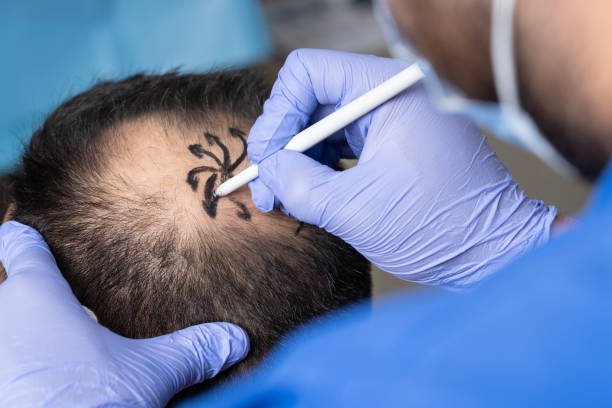
The number of grafts required for a Crown Hair Transplant in Dubai depends on the size of the thinning area, the amount of existing hair, the characteristics of the donor follicles, and the density the surgeon aims to achieve. There is no single graft count that suits every patient because the crown has a circular growth pattern and can cover a relatively large area.
A small patch of thinning may require a different approach from an extensive bald crown. The assessment should also account for future hair loss, since using too many donor grafts in one session can limit options for other areas later.
What Determines the Crown Hair Transplant Graft Count?
Graft planning begins with examining the crown's dimensions and the amount of native hair still present. A follicular graft typically contains one or more hair follicles, so graft numbers and individual hair counts are not interchangeable.
The surgeon also considers hair thickness, colour contrast between the hair and scalp, curl pattern, and the direction of growth. These factors affect how much visual coverage a given number of grafts can provide.
Crown Size and Degree of Thinning
A small area with mild thinning may need fewer grafts than a broad region with substantial hair loss. However, surface area alone does not determine the final count.
Existing miniaturized hairs can influence placement decisions, and the surgeon must avoid damaging viable native follicles while creating recipient sites.
Donor Hair Quality and Availability
The donor area, usually at the back and sides of the scalp, is evaluated for density, hair calibre, and suitability for harvesting. Patients with finer hair or limited donor density may have different coverage possibilities from those with thicker hair.
Donor supply is finite. A sound treatment plan preserves enough usable follicles for future needs instead of concentrating exclusively on the crown's immediate appearance.
Why the Crown Can Need More Planning Than Expected
The crown is not a flat, uniform patch. Hair grows around a whorl, with direction and angle changing across the region.
The surgeon must reproduce this pattern while distributing grafts across the recipient area. A poorly planned pattern may look unnatural even when a substantial number of grafts have been implanted.
Estimated Graft Planning Factors
| Factor | How it influences planning |
|---|---|
| Size of the thinning area | Larger areas may require broader coverage planning |
| Existing native hair | May affect graft distribution and protection of existing follicles |
| Hair calibre | Thicker hair may provide more visual coverage per strand |
| Curl and texture | Can influence how hair overlaps and covers the scalp |
| Donor density | Helps determine the amount that can be safely harvested |
| Future hair loss | May change how grafts are allocated across the scalp |
| Desired density | Must be balanced against realistic donor availability |
Any numerical graft estimate should follow an individual assessment. Online calculators and generic charts cannot reliably replace examination of the scalp.
Why Maximum Density Is Not Always the Best Goal
Patients sometimes assume that the best outcome comes from placing as many grafts as possible into the crown. In reality, the surgeon must balance the desired appearance with graft survival, donor limitations, recipient-site design, and the likelihood of continued hair loss.
The crown's natural swirl also affects visual coverage. Appropriate direction and distribution can be as important as the total graft count.
For details about the procedure and its planning considerations, see the Crown Hair Transplant in Dubai service page.
Common Questions About Crown Graft Numbers
“Can I choose the number of grafts I want?”
Patients can discuss their goals, but the surgeon should recommend a graft plan based on clinical findings, donor availability, and realistic expectations.
“Will more grafts guarantee thicker coverage?”
No. The final appearance also depends on hair characteristics, placement, graft survival, healing, and the amount of native hair remaining.
“Can the entire crown be restored in one session?”
That depends on the size of the area, donor supply, and the treatment plan. Some patients may be suitable for one procedure, while others may need a staged approach or a different strategy.
How Graft Planning Fits Into the Treatment Journey
- Scalp assessment: The clinician evaluates the crown, hair-loss pattern, and existing follicular activity.
- Donor evaluation: Density and follicular characteristics are reviewed to estimate available grafts.
- Recipient-area design: The crown's whorl and the distribution of native hair guide placement.
- Treatment planning: The surgeon explains the proposed graft count, limitations, and likely coverage.
- Follow-up: Healing and hair growth are reviewed over time, with the understanding that visible results develop gradually.
Plan for Long-Term Crown Coverage
Crown restoration should account for more than the current bald or thinning area. A carefully planned graft allocation can help balance immediate cosmetic goals with the possibility of future hair loss.
At Tajmeels Clinic, a consultation can help establish the condition of the crown, assess donor suitability, and determine a realistic approach to hair restoration.

 English
 Arabic
 French
 Spanish
 Portuguese
 Deutsch
 Turkish
 Dutch
Dutch
 Italiano
 Russian
 Romaian
 Greek
Greek