
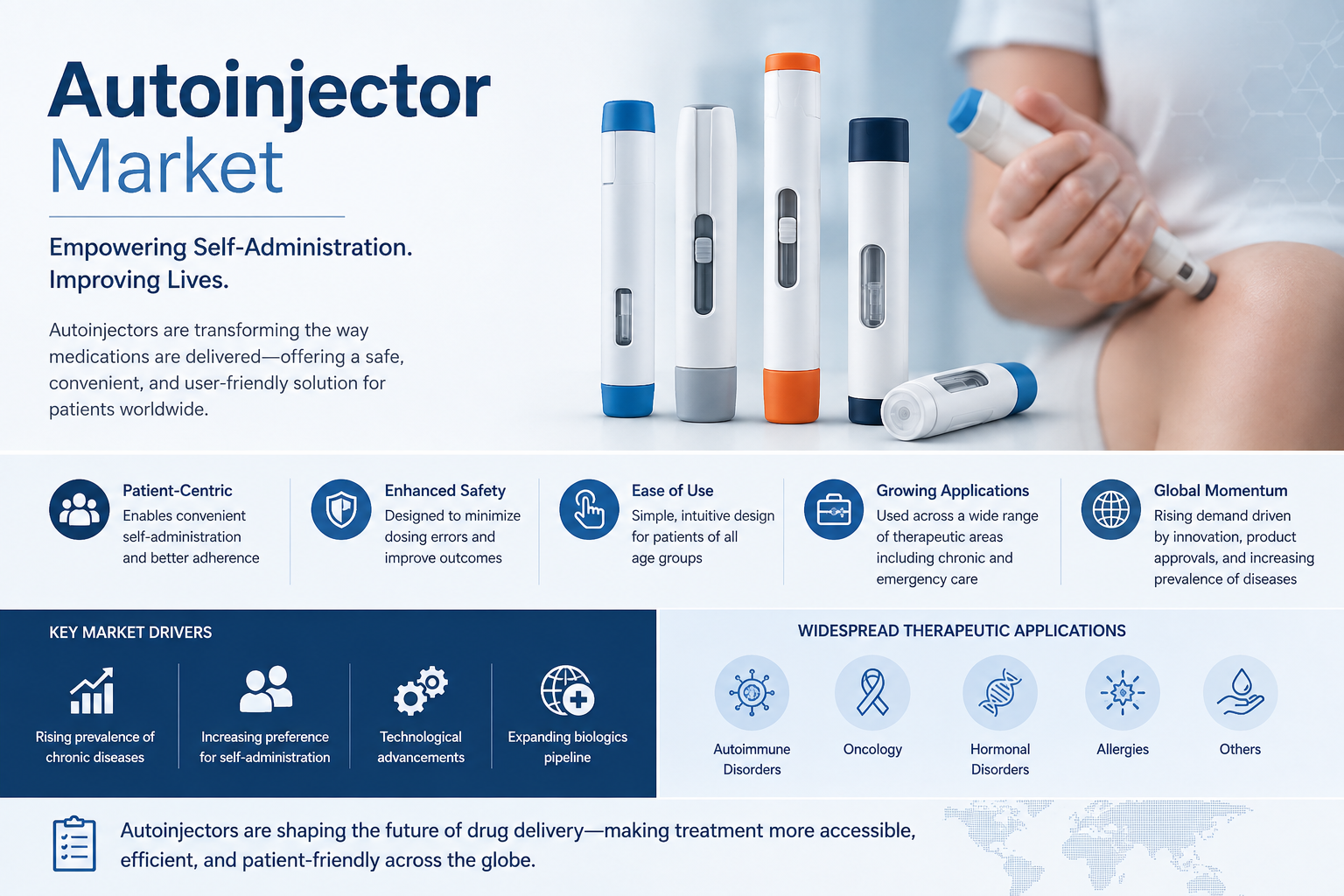
The rapid migration of healthcare delivery from formal clinical settings to patient homes is fundamentally reshaping the pharmaceutical industry. For patients managing chronic autoimmune disorders, severe allergies, or metabolic conditions, daily life used to revolve around frequent hospital visits for routine injections. Today, advances in drug delivery systems allow complex therapeutic regimens to be managed in a living room, quietly shifting power back into the patient’s hands.
At the center of this transition are autoinjectors—mechanized, single-dose medical devices designed to deliver liquid medication safely without requiring formal medical training. Demand for these intuitive delivery mechanisms is accelerating rapidly as biologics and viscous formulation therapies take center stage. According to a comprehensive market study in the Autoinjectors Market Report by Roots Analysis, the global autoinjectors market is estimated to grow from USD 170 billion in 2025 to reach USD 181 billion in 2026 and USD 299 billion by 2035, representing a higher CAGR of 5.7% during the forecast period. This trajectory highlights a permanent structural shift toward decentralized patient care and long-term self-administration.
Why Next-Generation Delivery Systems Matter for Patient Compliance
For decades, traditional needle-and-syringe methods served as the primary vehicle for parenteral administration. However, manually administering injectable drugs introduces friction points that directly compromise patient adherence. Needlestick anxiety, fear of pain, improper dosage measurement, and dexterity limitations frequently lead patients to delay or skip essential treatments entirely.
Modern self-injection devices solve these pain points through deliberate human-centered design. By shielding the needle before, during, and after administration, these platforms eliminate needle phobia and prevent accidental needlestick injuries. Automated insertion and controlled delivery rates ensure that the full therapeutic payload is delivered into the subcutaneous tissue every time, removing human error from the equation.
Beyond convenience, consistent self-administration directly improves therapeutic outcomes. When managing progressive diseases like multiple sclerosis or rheumatoid arthritis, maintaining steady serum drug concentration prevents painful flare-ups and avoids costly emergency room visits. Simplifying administration ultimately makes long-term treatment plans far easier for patients to stick with.
Technical and Operational Challenges Facing Device Developers
While autoinjecting devices appear straightforward to the end user, engineering them presents significant technical hurdles. The rise of targeted biologic therapies—such as monoclonal antibodies—has introduced increasingly dense, high-viscosity formulations that resist traditional fluid flow.
       [ Viscous Biologic Formulation ]
                      │
                      ▼
    ┌───────────────────────────────────┐
    │  Engineering Challenge: Viscosity  │
    └─────────────────┬─────────────────┘
                      │
        ┌─────────────┴─────────────┐
        ▼                           ▼
┌─────────────────┐       ┌──────────────────┐
│ Primary Container│       │ Spring Power &   │
│ Integrity       │       │ Controlled Drive │
└─────────────────┘       └──────────────────┘
Developing a mechanical system capable of pushing viscous drugs through thin-gauge needles without causing pain or damaging the drug molecule requires precise fluid dynamics engineering. Key development challenges include:
-
Primary Container Integrity: Ensuring glass syringes withstand high spring forces during rapid release.
-
Viscosity Management: Calibrating spring tension to handle dense solutions without prolonging injection time.
-
Controlled Drive Mechanisms: Preventing sudden mechanical impacts that could shock or discomfort the patient.
Addressing these engineering challenges demands strict adherence to global safety and quality standards. Regulatory authorities maintain strict requirements for combination products to ensure mechanical reliability and user safety. For instance, the U.S. Food and Drug Administration (FDA) provides clear guidance on human factors engineering for combination products, emphasizing that device design must actively minimize user error during home administration.
Key Technological Trends Reshaping Self-Injection Devices
As biopharmaceutical pipelines expand, device manufacturers are moving away from standard off-the-shelf hardware. Instead, they are adopting modular architectures that support customization across multiple therapy areas.
Key Innovations in Autoinjection
├─ Smart Connectivity (IoT Integration)
├─ Wearable Large-Volume Injectors (OBDS)
└─ Sustainability & Reusable Base Modules
1. Connected Health and Smart Injection Systems
Digital health integration is changing how physicians track patient adherence. Integrated Bluetooth modules, caps, and sensors turn standard devices into smart monitoring platforms. These systems automatically log the date, time, and dosage of each injection, syncing the data directly to a smartphone app or secure clinical dashboard. Real-time logging helps healthcare teams identify missed doses early and intervene proactively.
2. Large-Volume Wearable Injectors
Many emerging biologic therapies require dose volumes larger than the standard 1 mL to 2.2 mL range. To accommodate higher volumes without causing injection site pain, manufacturers are developing wearable body-worn devices, often referred to as On-Body Delivery Systems (OBDS). These devices adhere comfortably to the skin, delivering larger fluid volumes over an extended period via automated, slow micro-infusions.
3. Sustainable and Reusable Architectures
With millions of single-use devices discarded annually, sustainability has become a top priority for medical device packaging and engineering teams. Manufacturers are responding by introducing reusable drive units paired with disposable pre-filled cassettes or cartridges. This hybrid design significantly reduces plastic waste and lowers long-term manufacturing costs without compromising sterility or patient safety.
Best Practices for Integrating Human Factors Engineering
A drug delivery platform is only as effective as the patient’s ability to use it correctly. Integrating human factors engineering early in the development lifecycle prevents costly redesigns and ensures intuitive operation across diverse patient demographics.
-
Minimize Operational Steps: Reduce activation sequences to simple push-on-skin or single-button operations.
-
Incorporate Multi-Sensory Feedback: Provide clear audible clicks, visual window color shifts, and tactile cues to signal when the injection starts and finishes.
-
Design for Limited Dexterity: Shape the device housing with ergonomic grips so patients with joint pain or diminished hand strength can operate it comfortably.
Prioritizing ergonomic design directly aligns with international medical safety frameworks. Organizations like the World Health Organization (WHO) continuously advocate for safe injection practices and access to user-friendly medical technologies worldwide, underscoring the role of intuitive design in expanding global healthcare equity.
Strategic Future Outlook for Autoinjectors
Looking ahead, the role of automated injection platforms in modern medicine will continue to expand. As patent cliffs approach for major biologic drugs, biosimilar developers are leveraging advanced, patient-friendly delivery mechanisms to differentiate their products in competitive markets. A superior home delivery experience is rapidly becoming a key competitive advantage for biopharmaceutical companies.
Furthermore, the ongoing shift toward personalized medicine, home care delivery, and targeted therapies ensures that demand for reliable self-injection platforms will remain strong. Companies that invest in flexible, connected, and sustainable delivery technologies today will lead the next era of patient-centered care.
Conclusion
The evolution of autoinjectors reflects a broader movement within healthcare toward independence, safety, and personalized treatment. By bridging the gap between complex biopharmaceutical formulations and daily home use, these devices empower patients to take control of their health journeys. Moving forward, the successful integration of smart connectivity, ergonomic engineering, and sustainable manufacturing will determine which platforms set the standard for modern drug delivery.

 English
 Arabic
 French
 Spanish
 Portuguese
 Turkish
 Dutch
Dutch
 Italiano
 Russian
 Romaian
 Portuguese (Brazil)
 Greek
Greek